

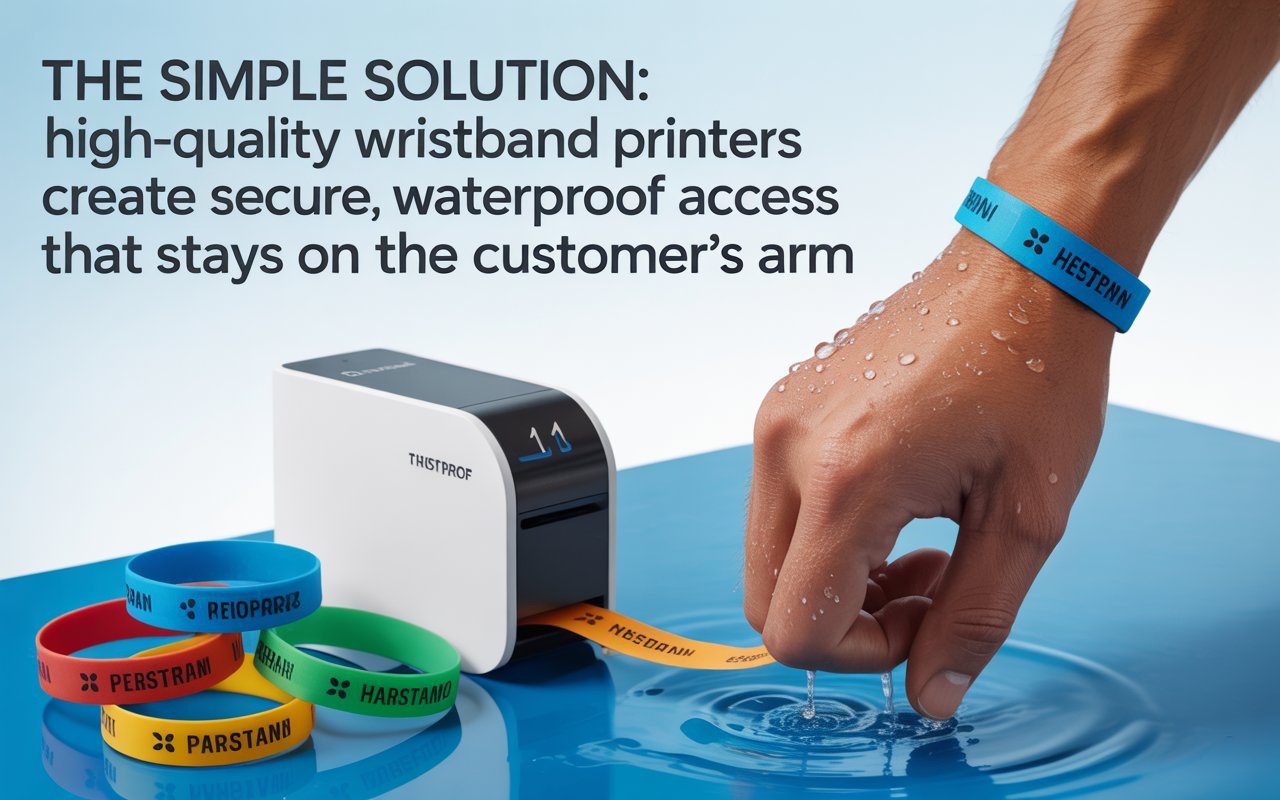
The Simple Solution: High-Quality Wristband Printers Create Secure, Waterproof Access That Stays on the Customer’s Arm
Every industry managing people at scale shares one problem: how do you verify identity and access quickly, accurately, and without friction? Whether it’s a hospital nurse confirming a patient before surgery, a festival staff member scanning 5,000 attendees at a gate, or a resort employee granting pool access — the challenge is the same. Paper wristbands rip. Ink fades. Manual checks create bottlenecks. And errors, in environments like healthcare, can be genuinely dangerous.
The answer that thousands of hospitals, event venues, correctional facilities, and resorts have arrived at independently is not complicated. It is a dedicated wristband printer — a purpose-built device that produces durable, readable, scannable, and waterproof identification directly onto a band that stays on the wearer’s wrist until deliberately removed.
This article covers everything decision-makers, procurement managers, and operations professionals need to know about wristband printing technology: what it is, how it works, which industries rely on it, which solutions lead the market, and how to implement one at your facility.
What Is a Wristband Printer?
A wristband printer is a specialized label or direct-printing device designed to produce wristbands — typically for patient identification, access control, or event management — using thermal printing technology applied directly to wristband media.
Unlike standard label printers, wristband printers are engineered for a very specific output: a band sized to fit a human wrist, made of materials that resist water, sweat, abrasion, and the repeated contact of daily wear. The printed content — which may include text, barcodes, QR codes, photos, color-coded access markers, or all of the above — must remain legible for hours, days, or weeks depending on the application.
The device feeds pre-sized wristband stock (supplied on rolls or as fanfold media), applies information via thermal transfer or direct thermal printing, and dispenses a finished wristband ready for immediate application to a patient, guest, or participant.
Core Technology: How Thermal Wristband Printing Works
The foundation of modern wristband printing is thermal printing — a contactless process that uses heat rather than ink cartridges or toner to produce an image.
Direct thermal printing passes the wristband media over a heated printhead element. The heat activates a heat-sensitive coating embedded in the media, turning it dark where applied. This method is cost-effective, fast, and requires no ink or ribbon. The tradeoff is sensitivity to prolonged heat and UV exposure — making it better suited for short-duration wristbands like single-day event passes or hospital wristbands used over days rather than weeks.
Thermal transfer printing interposes a ribbon — a thin film coated with wax, resin, or wax-resin compound — between the printhead and the media. Heat transfers the ribbon’s coating onto the wristband surface. The result is a more durable, UV-resistant, and chemically stable print. Thermal transfer is the preferred method for long-duration wristbands in environments involving water, sunlight, or chemical exposure.
Color thermal wristband printing — offered by a growing segment of manufacturers — adds the ability to print full-color graphics, photographs, and colored access-tier markings directly onto the wristband. This is particularly valuable in patient identification where color coding indicates care level, allergy alerts, or fall risk, and in events where different ticket tiers must be visually distinct at a glance.
Key Attributes and Features of High-Quality Wristband Printers
Not all wristband printers are created equal. The following attributes separate professional-grade systems from commodity alternatives.
Print resolution and barcode fidelity. A barcode or QR code printed at insufficient resolution fails to scan reliably, creating delays and errors. Leading wristband printers operate at 203 dpi to 600 dpi, with healthcare environments typically demanding 300 dpi minimum to ensure reliable barcode scanning at point of care.
Print speed. In high-volume environments — an emergency department seeing 300 patients daily, or a festival gate processing thousands of arrivals — speed matters. Professional thermal wristband printers achieve 4 to 8 inches per second, enabling a full wristband to be printed in under two seconds.
Waterproof and abrasion-resistant output. The combination of wristband media construction and thermal transfer printing creates output that resists water immersion, sweat, soap, and friction. This matters enormously in both hospital settings (hand washing, bathing, clinical procedures) and outdoor events (rain, swimming, physical activity).
Software integration and database connectivity. Modern wristband printers do not operate in isolation. They connect to hospital information systems, event ticketing platforms, property management systems, and access control databases. This integration enables the printer to pull patient records, booking data, or registration information and embed it — including barcodes, QR codes, or RFID data — directly into each printed wristband.
RFID and NFC encoding capability. An expanding category of wristband printers incorporates RFID or NFC encoding alongside visual printing. The result is a wristband that can be both visually read and electronically scanned — enabling touchless access control, cashless payment integration, and automated patient tracking.
Wristband media compatibility. Professional systems support a range of wristband materials: polypropylene (durable, waterproof, chemical resistant), Tyvek (lightweight, tear-resistant, cost-effective for short duration), synthetic paper composites, and hybrid media with RFID inlays. Compatibility with multiple media types makes a single printer adaptable across different use cases within one organization.
Connectivity and deployment flexibility. Contemporary wristband printers offer USB, Ethernet, Wi-Fi, and Bluetooth connectivity. Cloud-connected models can receive print jobs from any location in a facility or venue. Some systems include mobile printing capability — enabling security staff, nurses, or event coordinators to print from a tablet or smartphone.
Industries Served and Real-World Applications
Healthcare: Patient ID Wristband Printers at the Point of Care
Hospitals represent the most demanding and highest-stakes environment for wristband printing. Patient identification errors are a documented root cause of medication errors, transfusion reactions, and wrong-site surgeries. The Joint Commission and similar regulatory bodies mandate reliable patient identification at every point of care interaction.
Hospital wristband printers are now standard equipment in most North American, European, and Australian hospitals. They are placed at patient registration desks, emergency department triage stations, labor and delivery units, surgical suites, and pediatric wards. Each printed wristband carries the patient’s full name, date of birth, medical record number, and barcode or 2D data matrix code — enabling nurses and clinicians to scan the wristband against a medication administration record, blood product label, or surgical checklist before proceeding.
Color-coded wristbands — produced by customized color wristband printers — add an additional layer of safety. Red may indicate allergy or do-not-resuscitate status. Yellow signals fall risk. Purple communicates a specific clinical protocol. These visual cues are immediately readable by any clinical staff member, even in an emergency where electronic systems may not be immediately accessible.
A teaching hospital admitting 200 inpatients per day will print several hundred wristbands in a 24-hour period — not counting replacements for damaged or removed bands. The printer must be fast, reliable, and connected to the hospital information system without requiring manual data entry that introduces transcription errors.
Events and Entertainment: Customized Color Wristband Printers for Access Control
The live events industry — concerts, music festivals, sports venues, conferences, and trade shows — has adopted wristband printing as the primary access credential for most large-scale events. A wristband printed at entry communicates, at a glance, which access tier the wearer has purchased: general admission, VIP, backstage, media, or production.
Customized color wristband printers serve this market by enabling on-site, on-demand printing of full-color wristbands that match event branding, carry unique barcode or QR code identifiers linked to the ticketing database, and differentiate access tiers through both color and printed text.
The operational advantage is significant. Rather than pre-printing thousands of wristbands with fixed numbers and distributing them in envelopes — a process vulnerable to counterfeiting and loss — event organizers can print each wristband at the moment of arrival, linked to the attendee’s registered ticket. A lost wristband can be invalidated in the database and a replacement printed immediately. Wristbands for different days or zones can be distinguished by color without any staff training beyond visual recognition.
Waterproofing is particularly critical here. A festival wristband must survive rain, swimming, repeated hand washing, and 72 hours of continuous wear without becoming illegible or detaching.
Hospitality and Resorts
All-inclusive resorts, cruise lines, water parks, and hotels use wristbands to manage guest access to facilities, track meal plan entitlements, enable cashless purchases, and distinguish between guest tiers. Wristband label printers connected to property management systems can print a guest’s wristband at check-in, encoding their room number, meal plan level, and credit authorization directly into a barcode or RFID chip embedded in the band.
This eliminates room key cards lost at the pool, meal vouchers forgotten in beach bags, and the need for guests to carry wallets to the pool bar. The wristband becomes the guest’s all-in-one credential for the duration of their stay.
Corrections and Secure Facilities
Jails, prisons, detention centers, and mental health facilities use wristband printing as a mandatory component of inmate and patient tracking. Each wristband carries a unique identifier linked to the individual’s record in the facility management system. Officers can scan a wristband to instantly confirm identity, retrieve records, and document movement through a facility.
In this environment, tamper resistance is paramount. Wristbands for secure facilities use one-time clasp mechanisms that cannot be reattached once removed, and materials designed to be clearly visible if cut or tampered with.
Manufacturing and Industrial Environments
Visitor management in manufacturing plants, chemical facilities, and research campuses uses wristband printing to issue time-limited, zone-specific access credentials. A visitor wristband printed at reception carries a barcode linked to their appointment record, indicates which areas they are authorized to access, and includes an expiry date that turns the wristband’s printed color coding invalid when the visit concludes.
Wristband Printer Market: Leading Solutions Compared
The wristband printer market is served by a small number of established players whose products dominate in specific verticals, alongside an expanding group of specialized manufacturers addressing particular niches.
Zebra Technologies is the dominant name in healthcare wristband printing. Zebra’s ZD510-HC is purpose-built for patient identification, connecting directly to EMR systems, producing 300 dpi output at clinical-grade barcode quality, and supporting the full range of healthcare wristband media. Its position in the market is established partly through deep integrations with Epic, Cerner, and other major hospital information platforms.
Brady Corporation serves the industrial and event markets with wristband printers that emphasize durability and media flexibility. Brady’s systems support an unusually wide range of wristband materials and are frequently deployed in environments requiring chemical resistance.
Boca Systems has a strong presence in the event ticketing and access control market, with wristband printers designed for high-volume, high-speed operation at stadium and festival gates.
Matica Technologies and HID Global serve the secure credentialing and card/wristband issuance markets, with systems incorporating RFID encoding alongside printing — relevant for resort, corporate campus, and secure facility applications.
The key differentiators across these products are resolution (203 vs 300 vs 600 dpi), print speed (inches per second), RFID encoding capability, supported media types, software ecosystem integrations, and total cost of ownership including media and ribbon costs.
For organizations evaluating options, the most important factors are: the software system the printer must connect to, the daily print volume, the required wristband durability (which determines media selection), and whether RFID/NFC encoding is required alongside visual printing.
Implementation Overview: Deploying a Wristband Printing System
Deploying a wristband printing system involves hardware selection, software integration, media selection, staff training, and workflow design. The following overview covers the key decisions at each stage.
Hardware selection begins with defining the environment and volume. A single registration desk printing 50 wristbands per day has very different requirements than a trauma center printing 400 wristbands per 24-hour period. Print speed, duty cycle (the printer’s rated daily volume), connectivity options, and media compatibility all factor into hardware choice. For healthcare, select a printer carrying relevant healthcare-grade certifications and verified integrations with your specific EMR platform.
Software integration is often the most complex phase of deployment. Hospital wristband printers must connect to ADT (admission, discharge, transfer) feeds from the hospital information system so that patient demographic data populates each wristband automatically — eliminating manual data entry. Event wristband systems integrate with ticketing platforms via API. Resort systems connect to property management software. Most major printer manufacturers provide pre-built connectors and middleware for common platforms; custom integrations require technical resources from either the vendor or internal IT.
Media selection requires matching the wristband material to the wear duration and environment. Tyvek media suits short-duration applications (single-day events, outpatient visits). Polypropylene suits multi-day and waterproof requirements. Wristbands with RFID inlays must match the printer’s encoding capability in both frequency (HF for NFC, UHF for longer-range RFID) and chip type. Order sufficient media inventory to avoid operational disruption — wristband media is a consumable that requires ongoing procurement.
Workflow design determines where printers are positioned, who operates them, and what triggers a print job. In a hospital, the trigger is typically patient registration in the ADT system — which automatically queues a wristband print job to the nearest printer. In an event, the trigger is ticket scan at entry. In a hotel, it is check-in confirmation. Designing this workflow carefully prevents duplicate prints, missed prints, and the need for manual data entry.
Staff training is typically minimal for well-designed systems, since the print job is triggered automatically. Staff need to understand media loading, basic error recovery (paper jams, ribbon errors), and the process for reprinting a damaged or lost wristband.
ROI and Operational Impact
The business case for dedicated wristband printing systems rests on several measurable outcomes.
In healthcare, reducing patient identification errors has both direct cost implications (avoided adverse events, reduced liability exposure) and regulatory compliance value. Studies in clinical settings have consistently shown that barcode-enabled patient identification at point of care significantly reduces medication administration errors. The cost of a dedicated hospital wristband printer — typically in the range of $500 to $3,000 depending on capability — is negligible against the cost of a single serious adverse event attributable to patient misidentification.
In events, on-demand wristband printing eliminates the cost of pre-printing large wristband quantities, reduces counterfeiting losses, and enables real-time access control adjustments. Venues report faster entry processing and reduced staff requirements at access points when wristband scanning replaces manual ticket collection.
In hospitality, RFID wristbands increase on-property spending by making cashless purchases frictionless, reduce front desk calls about lost room keys, and improve guest satisfaction scores — measurable outcomes that affect revenue and repeat booking rates.
FAQ: Everything You Need to Know About Wristband Printers
What is the difference between a wristband label printer and a dedicated wristband printer?
A wristband label printer refers to a standard label printer — often a desktop thermal device — configured to print on wristband-format media. These offer a cost-effective entry point but may lack the speed, duty cycle, and specialized wristband media feed mechanisms of purpose-built wristband printers. Dedicated wristband printers, by contrast, are engineered specifically for wristband stock with precision feed mechanisms that handle the curves and thicknesses of wristband media more reliably, and with software integrations optimized for wristband-centric workflows. For high-volume environments — healthcare, large events — a dedicated printer is the more reliable long-term investment.
How do thermal wristband printers differ from inkjet or laser alternatives?
Thermal wristband printers use heat to produce an image — either directly on heat-sensitive media (direct thermal) or by transferring ink from a ribbon onto the media (thermal transfer). The result is fast, reliable printing with no ink cartridges or toner to manage, and output that is inherently more resistant to smearing and moisture than inkjet. Laser printers are unsuitable for wristband media due to the heat and pressure of the fusing process. For wristband applications specifically, thermal printing is the industry standard for good reason: it is faster, more durable, and lower maintenance than alternatives.
What makes a wristband waterproof, and how long does a printed wristband last?
Waterproofing comes from two sources: the wristband media substrate and the printing method. Polypropylene wristband media is inherently water-resistant. Thermal transfer printing applies the image as a fused layer that does not dissolve in water. Together, a polypropylene wristband printed with thermal transfer can withstand repeated water immersion, sweat, and friction for multiple days to several weeks. Direct thermal wristbands on Tyvek or synthetic paper substrates are also water-resistant and suitable for typical hospital stays of several days. Media manufacturers specify rated wear duration — selecting media matched to your required wear period is the key variable.
Can customized color wristband printers produce photo-quality images and full branding?
Yes. Color thermal wristband printers — using specialized multi-color ribbons or dye-sublimation mechanisms — can produce full-color wristbands including photographs, gradient graphics, and full brand-color logos. This capability is most commonly used in events (branded wristbands for sponsorship value), hospitality (personalized guest wristbands), and healthcare (color-coded patient wristbands with facility branding). The print quality and color gamut vary by system; evaluating sample prints from the specific media and ribbon combination you intend to use is an important step in the procurement process.
How does a patient ID wristband printer integrate with hospital information systems?
Most hospital wristband printers integrate with the hospital information system via an HL7 ADT (Admission, Discharge, Transfer) interface — the standard messaging protocol for patient demographic and movement data. When a patient is registered or transferred, the ADT event triggers a print job containing the patient’s name, date of birth, medical record number, and a barcode or 2D matrix code encoding these fields. Middleware provided by the printer manufacturer or a third-party integration vendor translates the HL7 message into a print-ready format for the specific printer. Cloud-based integration models are also increasingly common, particularly for health systems standardizing on a single wristband printing platform across multiple facilities.
What is the total cost of ownership for a wristband printer system?
Hardware cost is typically the smallest component of total cost of ownership. The ongoing costs are media (wristband stock) and, for thermal transfer printers, ribbons. A hospital printing 200 wristbands per day might consume 4–5 rolls of wristband media and 2–3 ribbon rolls per week. At current consumable pricing, this represents a modest daily operational cost — far below the cost of alternatives like pre-printed wristband stock requiring manual data application. Factor in software licensing fees if the printer connects to proprietary middleware, maintenance contracts, and the cost of spare hardware for high-availability environments. Request a total cost of ownership model from vendors that accounts for your specific daily volume and media selection.
Are RFID wristband printers worth the additional investment?
RFID-encoding wristband printers carry a higher upfront cost — typically two to four times the price of a print-only equivalent — and require RFID wristband media, which costs more than standard stock. The business case for RFID depends on your specific application. In hospitality, RFID supports cashless payments and room access, while higher on-site spending often offsets the added cost within one or two seasons. For events, it allows contactless entry and live crowd monitoring. In healthcare, patient tracking with RFID enhances workflow efficiency in critical units but depends on installing readers across the facility. Evaluate the ROI in your specific context rather than treating RFID as a universal upgrade.
Conclusion: The Wristband Printer Is the Simplest Solution to a Complex Problem
Organizations managing dozens, hundreds, or thousands of people at a time face a core operational challenge that has not fundamentally changed: how do you know who someone is, what they are authorized to access, and how do you act on that information instantly and accurately?
The wristband is the oldest answer to that question. It stays on the person, it travels with them through every environment, and it is visible without any technology required to read it. The wristband printer simply makes that answer better: faster, more accurate, more durable, more connected to the digital systems that organizations already depend on, and capable of carrying far more information than a handwritten or pre-stamped alternative ever could.
Whether you are evaluating hospital wristband printers to improve patient safety at point of care, customized color wristband printers for event access control, thermal wristband printers for an all-inclusive resort, or wristband label printers for a visitor management program — the decision calculus is similar. Match the print technology to the wear duration and environment. Align connectivity with your existing software ecosystem. Ensure the system’s daily capacity meets your operational demands. Choose a vendor that offers reliable support to keep everything running when it matters most.
The right wristband printer does not require your staff to think about it. It simply works — producing a secure, waterproof, readable credential that stays exactly where it needs to be: on the customer’s arm.