

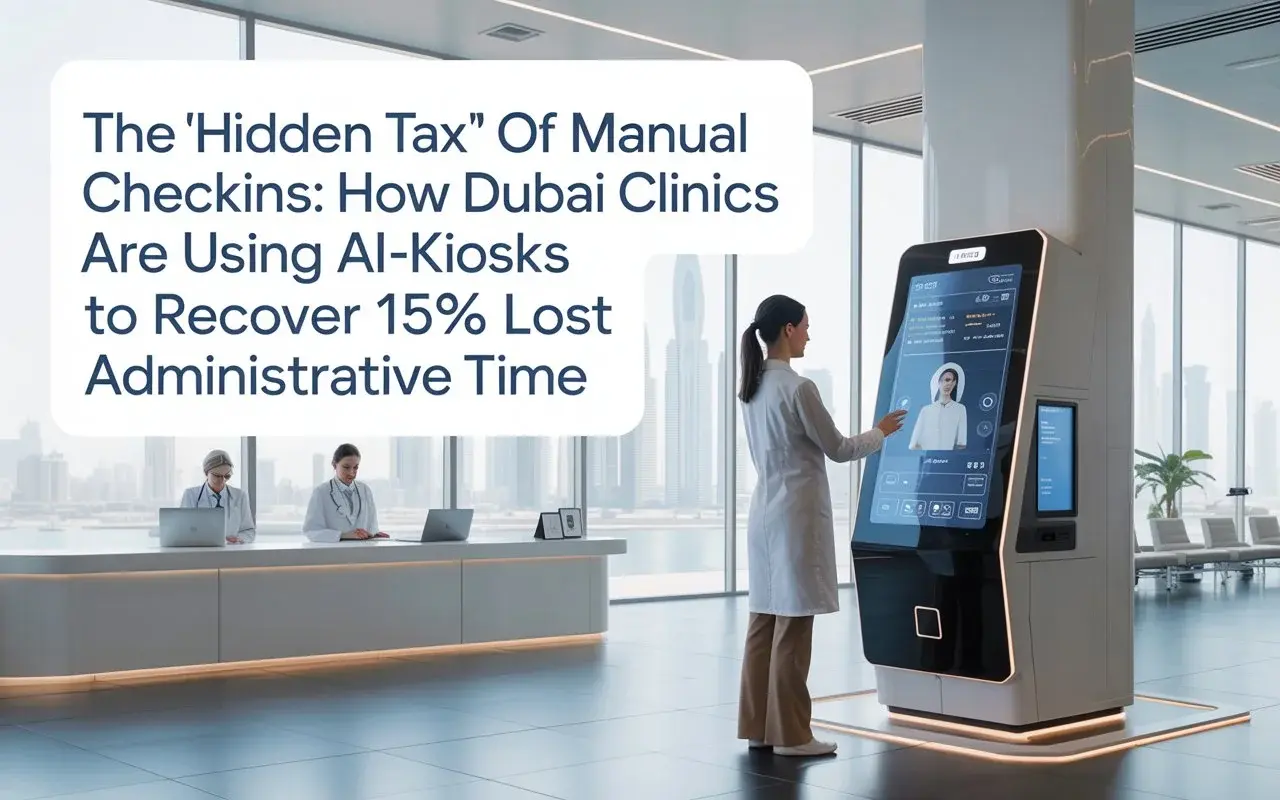
The “Hidden Tax” of Manual Check-ins: How Dubai Clinics Are Using AI-Kiosks to Recover 15% in Lost Administrative Time
Introduction: The Invisible Cost Draining Dubai’s Private Clinics
Every day, across hundreds of private clinics in Dubai, something quiet and expensive is happening at the front desk. A patient walks in. A receptionist looks up. Papers shuffle. Insurance cards get photocopied. A form is handed over on a clipboard. A staff member types everything in — again — into a system that already partially holds the data.
This is the hidden tax. Nobody invoices it. No CFO line-item captures it cleanly. But healthcare administrators who have looked closely at their operational data know it’s real, it compounds daily, and it’s costing Dubai clinics an estimated 15% of total administrative working hours — hours that don’t produce care, don’t generate revenue, and don’t build patient loyalty.
In a market as competitive and compliance-intensive as Dubai’s private healthcare sector — governed by the Dubai Health Authority (DHA) and increasingly benchmarked against international standards — that 15% gap is no longer acceptable. Which is why forward-thinking clinic operators are turning to AI-powered patient check-in kiosks not as a luxury upgrade, but as a measurable operational fix.
This article breaks down the real cost of manual check-in processes, explains how AI-kiosk systems work inside a clinical environment, and shows — with data — how clinics across the UAE are reclaiming lost time, reducing errors, and improving patient satisfaction simultaneously.
What Is the “Hidden Tax” of Manual Check-In?
The phrase “hidden tax” refers to operational costs that are real but not directly visible on a P&L statement. In clinic administration, it shows up in four specific ways:
- Duplicate Data Entry Patient information captured verbally or on paper forms gets re-entered into the clinic management system (CMS) by front desk staff. This process is slow, error-prone, and completely redundant if a digital intake layer exists.
- Staff Bottlenecking at Peak Hours Between 9 AM and 12 PM, most clinics in Dubai experience 60–70% of their daily walk-in volume. Without automated intake, one or two receptionists become the single point of failure for the entire patient flow. Queue times rise. Patient dissatisfaction builds. Staff stress peaks.
- Insurance Eligibility Verification Delays Manual verification of insurance coverage — cross-checking policy numbers, network status, co-pay amounts — can take 4 to 8 minutes per patient when done manually. Multiply that across 40–60 patients per day and you have a half-day of staff time consumed by a single administrative task.
- Compliance Documentation Gaps DHA-mandated documentation — consent forms, patient declarations, Emirates ID verification — must be collected at the point of check-in. When done manually, forms get missed, signatures are forgotten, and staff must chase patients retroactively. Each correction costs time and creates audit risk.
Together, these four inefficiencies form the hidden tax. And in Dubai’s high-rent, high-wage operating environment, they carry a real financial cost.
What Is an AI-Powered Patient Check-In Kiosk?
An AI-powered patient check-in kiosk is a self-service terminal — typically a touchscreen tablet or standing display unit — that automates the patient intake process from arrival to seat. It is not simply a digital form. The “AI” component refers to the system’s ability to read documents, verify identity, cross-reference databases in real time, and adapt the intake workflow dynamically based on patient type, visit reason, and insurance profile.
In a Dubai clinic context, a fully integrated AI-kiosk performs the following functions:
- Emirates ID scanning via optical character recognition (OCR) to auto-populate patient demographic data
- Insurance card reading with live eligibility verification against payer networks including Daman, AXA Gulf, Oman Insurance, and Dubai Insurance Company
- Dynamic form presentation — showing only the consent forms relevant to the visit type (GP visit vs. specialist vs. diagnostic)
- Appointment confirmation and queue assignment — checking the patient in against their scheduled slot and assigning a real-time queue position displayed on a waiting area screen
- Arabic and English language support with some systems extending to Hindi, Urdu, Tagalog, and Mandarin — reflecting Dubai’s patient demographic reality
- Integration with clinic management software such as Nabidh (DHA’s health information exchange), Shafafiya, iClinic, Clinic Master, and international platforms like Practo and Jane App
The result is a check-in process that takes the patient 90 seconds instead of 6 minutes — and requires zero staff involvement for standard, uncomplicated visits.
Core Attributes and Features: What Separates High-Performance Kiosk Systems
Not all kiosk systems deliver equal outcomes. The performance gap between entry-level digital intake tools and purpose-built AI-kiosk platforms is significant. Here are the attributes that define the difference:
Real-Time Insurance Eligibility Engine
The most impactful single feature. A kiosk that connects live to insurance clearinghouses — verifying active coverage, co-pay amount, network tier, and benefit limits at the moment of check-in — eliminates the most time-consuming manual step. Clinics using live eligibility engines report a reduction in billing disputes of up to 30% because the financial agreement is confirmed before the patient sees the doctor, not after.
Adaptive Intake Logic
Rather than presenting every patient with the same 12-question form, AI-driven intake systems use conditional logic. A patient presenting for a follow-up dermatology visit does not need to fill in cardiovascular history. The system knows this. Adaptive forms reduce completion time by an average of 40% and patient abandonment of the intake process drops significantly.
Biometric and Document Verification
Dubai’s regulatory environment and patient base make document verification both a compliance requirement and a practical necessity. Advanced kiosk systems use camera-based passport and Emirates ID reading combined with liveness detection to confirm patient identity. This reduces the risk of insurance fraud, duplicate record creation, and identity mix-ups — all of which generate significant administrative remediation work downstream.
Multilingual UX Architecture
A kiosk that only functions comfortably in English is a kiosk that will slow down a significant portion of Dubai’s patient population. High-performing systems are designed with multilingual UX from the ground up — not translation overlays — meaning the workflow logic, form field ordering, and directional prompts are all culturally adapted, not just linguistically translated.
EMR/HMS Bi-Directional Integration
The kiosk must write data into the clinic’s existing system of record — not create a parallel data silo. Best-in-class implementations use HL7 FHIR APIs to push verified patient data directly into the electronic medical record (EMR) or hospital management system (HMS), eliminating the re-entry step entirely. When this integration is correctly implemented, the receptionist’s role at check-in shifts from data entry to exception handling and patient experience management.
Queue Intelligence and Waitlist Management
Beyond check-in, AI-kiosk platforms that include predictive queue management provide the clinic with real-time visibility into patient flow. The system can identify when a specific physician’s schedule is running behind, automatically notify waiting patients via SMS, and dynamically reorder the queue based on urgency flags set during intake.
The 15% Time Recovery: Where Does It Actually Come From?
The claim that AI-kiosks help clinics recover 15% of administrative time is specific and worth unpacking. Based on operational data from mid-size Dubai clinics (30–80 daily patient visits), the time recovery distributes across four categories:
Insurance Verification (38% of recovered time) The elimination of manual eligibility calls and payer portal lookups produces the largest single time saving. For a clinic seeing 50 patients a day, this alone can return 3–4 staff hours.
Duplicate Data Entry (28% of recovered time) When the kiosk reads the Emirates ID and auto-populates the CMS, the receptionist never types a patient’s name, DOB, or address again. At 2–3 minutes per patient, the arithmetic becomes significant fast.
Compliance Documentation (20% of recovered time) Digital consent forms with e-signature capture, time-stamped and auto-filed, eliminate the paper-chasing that consumes significant time in DHA audit cycles.
Queue and Flow Management (14% of recovered time) Automated queue assignment reduces the ad-hoc verbal traffic between reception and patients, freeing staff for higher-value interactions.
Use Cases: Which Dubai Clinics Benefit Most?
AI-kiosk systems are not equally valuable across all clinic types. The ROI calculation varies based on patient volume, case mix, insurance penetration, and staff structure. Here is where the impact concentrates:
Multispecialty Polyclinics
These clinics — common across Business Bay, JLT, and Al Barsha — see high volumes of working professionals who are insurance-covered and time-sensitive. AI-kiosks align perfectly with this patient profile: Emirates ID scan, quick insurance confirmation, queue assignment. These patients actively prefer self-service. Polyclinics with 60+ daily visits typically recover staff time equivalent to 0.5 to 1.0 full-time administrative positions.
Diagnostics and Radiology Centers
Patients arriving for lab work or imaging are typically pre-referred. They carry referral numbers, insurance approvals, and specific test orders. A kiosk that validates the referral number, confirms insurance pre-authorization, and routes the patient directly to the relevant department removes multiple manual steps and eliminates a category of errors — patients checked in for the wrong test type — that are both costly and clinically significant.
Dental Group Practices
Multi-chair dental practices in Dubai see high insurance claim volumes, complex treatment plan documentation requirements, and a patient mix that spans corporate clients (company insurance, DHA MandaCare) and self-pay visitors. Kiosks that capture visit reason, current medications, and allergy data during intake reduce consultation time and improve clinical documentation quality.
Corporate Health and Occupational Clinics
Clinics embedded in large business districts — DIFC, Dubai Silicon Oasis, Dubai Internet City — serve employee populations on specific corporate insurance plans. These clinics often run high volumes during lunch hours with predictable, repeating patient profiles. AI-kiosks in this setting reduce per-visit overhead dramatically because the system recognizes returning patients and pre-fills their profiles.
Wellness and Preventive Health Centers
An emerging category in Dubai, these clinics often serve health-conscious, digitally comfortable patients who are comfortable with self-service technology. For these environments, kiosks also serve a marketing function — the experience communicates modernity and competence before the patient enters the consultation room.
Competitive Landscape: What Are the Alternatives?
Dubai clinic operators evaluating AI-kiosk systems typically encounter the following alternatives. Here is how they compare:
Traditional Paper-Based Intake The incumbent in most small-to-mid-size clinics. Zero capital cost but maximum ongoing cost in staff time, error rates, compliance risk, and patient experience. The hidden tax is highest here.
Basic Digital Forms (Tablet-Based) A step up from paper but not a true kiosk solution. Patients fill digital forms on a tablet at the reception desk. Data still typically requires manual entry into the CMS unless integration is built. Insurance verification is still manual. Improvement in patient experience but limited operational gain.
Reception Management Software (Without Kiosk Hardware) Platforms like Waitwhile or Qminder add queue management capability but do not address data entry, insurance verification, or document compliance. They solve one part of the problem.
Full AI-Kiosk Platforms (AEC-INT and Equivalents) Purpose-built systems combining kiosk hardware, OCR-based document reading, live insurance eligibility, adaptive form logic, multi-language UX, and bi-directional EMR integration. These represent the highest upfront investment but the highest operational return. The differentiation within this category comes from depth of local insurance network integration, Arabic language UX quality, and DHA compliance certification.
When evaluating vendors, Dubai clinic operators should ask specifically: Does the system have live integration with Daman, AXA Gulf, and Oman Insurance? Is it registered with Dubai Health Authority? Does it connect to Nabidh? Is the Arabic interface natively designed or translated? These questions separate genuine UAE-market solutions from international platforms adapted for the region.
Implementation Overview: What Does Deployment Actually Look Like?
Understanding implementation realities is critical for clinic decision-makers. The most common failure mode in healthcare technology adoption is underestimating the integration work and overestimating the speed of staff adoption.
Phase 1 — Assessment and Configuration (Weeks 1–3) The vendor audit of the clinic’s existing CMS, insurance mix, patient demographic profile, and physical space. Kiosk placement is more important than most operators realize. A kiosk placed poorly — facing away from the entrance, requiring staff direction to find — will see abandonment. Well-placed kiosks (visible on entry, with clear wayfinding) see 70–85% patient adoption within the first month.
Phase 2 — Integration Development (Weeks 3–6) The technical work of connecting the kiosk system to the CMS via HL7 FHIR or proprietary API. For clinics running standard platforms (iClinic, Clinic Master, Practo), pre-built connectors typically exist. For custom HMS setups, integration development adds time and cost.
Phase 3 — Staff Training and Parallel Running (Weeks 6–8) This phase is frequently underinvested. Staff need to understand not just how to support the kiosk but how their role changes as a result. The receptionist who spent 60% of their time on data entry now needs to redirect that capacity toward exception handling, patient support, and care coordination. This is a role evolution, not a role elimination — and framing it correctly internally is important for adoption.
Phase 4 — Go-Live and Optimization (Week 8 onward) The first 30 days of live operation generate the most valuable data: which patient types are abandoning the kiosk flow, where the insurance verification is failing, which form fields are causing friction. Good vendors provide active optimization support during this period. Clinics that treat go-live as the finish line typically plateau at 40–50% of the recoverable efficiency gain. Clinics that optimize actively typically reach 85–90%.
Frequently Asked Questions
Q1: Is an AI check-in kiosk compliant with Dubai Health Authority requirements for patient data privacy?
This is the first question any responsible clinic operator should ask, and the answer depends on the vendor. The DHA’s Health Data Protection Standard (HDPS) establishes strict requirements for how patient health information is collected, stored, transmitted, and accessed. Compliant AI-kiosk systems must store data within UAE borders (or comply with approved cross-border transfer frameworks), use encrypted data transmission, maintain audit logs of all data access events, and obtain explicit digital consent from patients at point of intake. Before procuring any kiosk system, clinics should request the vendor’s DHA compliance documentation and verify Nabidh integration status. AEC-INT-certified platforms are built with HDPS compliance as a baseline architecture requirement, not an afterthought.
Q2: How long does it take for a Dubai clinic to see measurable ROI from an AI-kiosk investment?
The payback period depends heavily on daily patient volume and current staff configuration. For a clinic seeing 40+ patients per day with at least two front-desk staff, the operational time savings typically offset the system cost within 8 to 14 months. This calculation includes hardware amortization, software licensing, and integration development costs. Beyond direct time savings, the ROI calculation should include reduction in billing disputes (typically 20–30% reduction with live eligibility), reduction in compliance penalties from documentation gaps, and — harder to quantify but real — improvement in patient satisfaction scores that drive repeat visits and referrals.
Q3: What happens to patients who are not comfortable using a self-service kiosk — elderly patients, patients with low digital literacy, or first-time visitors?
This is an important operational design question. AI-kiosk systems are designed to supplement, not replace, human reception. Best practice implementation maintains at least one staffed reception point for patients who need assistance or prefer human interaction. The kiosk adoption curve in Dubai clinics suggests that elderly patients and first-time visitors typically require staff support for the first visit but often self-serve successfully on subsequent visits once they are familiar with the flow. Kiosk UX designed for Dubai — large text options, Arabic-first routing, clear iconography — reduces the accessibility barrier significantly.
Q4: Can AI check-in kiosks handle walk-in patients as effectively as appointment patients?
Yes, though the workflow differs. For appointment patients, the kiosk validates the existing booking, confirms identity, and runs insurance eligibility — a 60 to 90-second process. For walk-in patients, the kiosk collects full demographic and insurance information, presents relevant intake forms, and either routes the patient to the queue or flags for staff review if the visit type requires clinical triage. Some urgent care and general practice settings add a clinical pre-screening layer to the walk-in kiosk flow — collecting chief complaint, symptom duration, and vital signs via integrated peripherals — which allows clinical staff to prioritize the queue intelligently before the patient enters the consultation room.
Q5: How does a clinic evaluate whether its current administrative inefficiency is significant enough to justify a kiosk investment?
A practical starting point is a 5-day time audit. Ask front-desk staff to record, in 15-minute intervals, what activity they are performing. Most clinics that conduct this audit find that 40–55% of front-desk time in the first four hours of the day is consumed by check-in-related tasks: greeting, form distribution, data entry, insurance verification, and document filing. If that proportion is confirmed in your clinic, and your daily patient volume exceeds 30, the financial case for an AI-kiosk is likely to be positive. AEC-INT offers a complimentary operational assessment for Dubai clinics that includes this time-audit methodology and a customized ROI projection based on your specific payer mix, CMS, and patient volume profile.
Q6: What languages should a kiosk in a Dubai clinic support?
Arabic and English are the functional minimum. Given Dubai’s demographic reality, clinics serving significant South Asian patient populations should prioritize Hindi, Urdu, and Malayalam. Clinics in areas with large Filipino, Chinese, or Russian patient communities should consider Tagalog, Mandarin, and Russian respectively. Language support should be evaluated not just at the label level but at the UX design level — directional conventions, reading direction, and cultural expectations around form design differ between language communities and affect completion rates.
Conclusion: The Clinics That Act Now Will Define the Standard
Dubai’s private healthcare sector is in the middle of a quiet operational transformation. The clinics that are moving first on AI-powered administrative automation are not doing so because it is the fashionable thing to do. They are doing it because the numbers are clear, the technology is mature, and the competitive pressure is building.
The hidden tax of manual check-in is not going to resolve itself. Staff wages in Dubai are not declining. DHA compliance requirements are not getting simpler. Patient expectations — shaped by digital experiences across every other sector of their lives — are not getting lower.
A 15% recovery in administrative time is not a marginal efficiency gain. For a clinic running a full front-desk team, it is the equivalent of recovering half a staff position’s productive capacity every day. Redirected toward patient experience, clinical coordination, and proactive care management, that recovered capacity produces compounding returns.
The clinics that understand this — and act on it — will set the operational standard that others follow. The clinics that wait will find themselves managing a widening efficiency gap against competitors who are serving more patients, more accurately, with less friction, and at lower per-patient administrative cost.
AEC-INT works with private clinics and healthcare groups across the UAE to design, implement, and optimize AI-powered administrative systems that meet DHA standards, integrate with existing clinic infrastructure, and deliver measurable results. If you are evaluating whether an AI-kiosk system is right for your clinic, the right starting point is a conversation about your specific operational context — not a generic product demonstration.
