

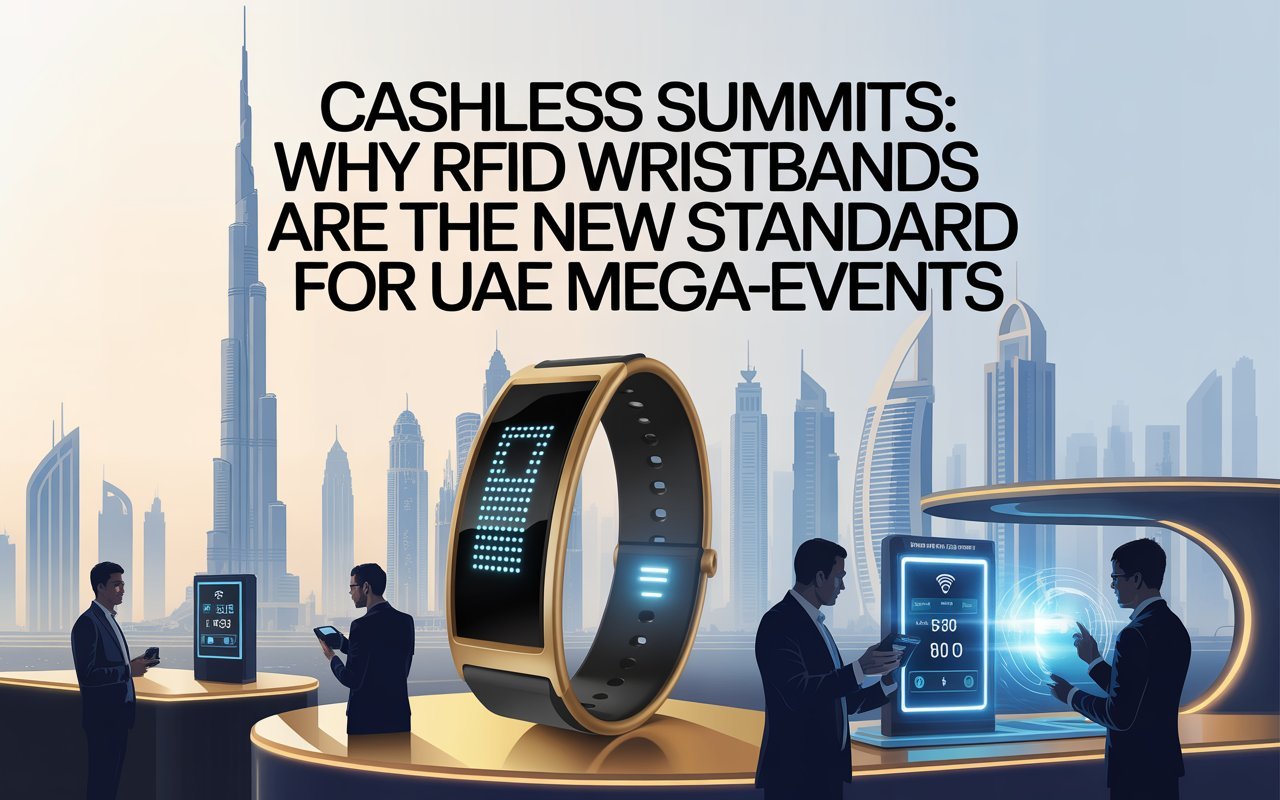
Cashless Summits: Why RFID Wristbands Are the New Standard for UAE Mega-Events
The Currency Problem at the Heart of Every Large-Scale Event
Picture this: 80,000 people converge on a UAE mega-venue — an expo pavilion in Abu Dhabi, a desert music festival outside Dubai, or a three-day international trade summit. The doors open at 9 AM. By 9:22, four concession queues are 60 people deep. A sponsor activation booth is turning away visitors because the card terminal just went offline. A performer’s merchandise table is running short on AED 100 notes. Security is flagging a counterfeit bill at Gate 7.
None of these are edge cases. They are the predictable, recurring friction points of running large-scale events on cash or legacy card payment infrastructure. And in a region where the UAE government has publicly committed to a cashless economy — with the Central Bank of the UAE targeting 90% digital payment penetration by 2026 — continuing to run mega-events on paper currency is not just inefficient. It is increasingly incongruent with the national economic identity.
The solution that event operators across the Emirates, Saudi Arabia, and the wider GCC have converged on is not a new point-of-sale system or a digital wallet app. It is something far more tactile, wearable, and immediate: RFID wristbands.
This is where AEC-INT enters the picture. As a specialist in RFID wristband solutions for the UAE and GCC events market, AEC-INT has built its reputation around one core conviction: that the transition to fully cashless events should be seamless for organizers, invisible to attendees, and uncompromising on security. This article examines why RFID wristband technology has become the defining payment and access infrastructure for UAE mega-events, how AEC-INT’s “Silicon & Fabric” product range serves different event profiles, and what operators need to know before deploying a fully cashless environment.
What Are RFID Wristbands? Defining the Entity
RFID stands for Radio Frequency Identification. An RFID wristband is a wearable band embedded with a microchip and a copper or aluminum antenna coil. When held within proximity of an RFID reader (typically 1–10 cm for high-frequency 13.56 MHz systems), the chip transmits a unique identifier wirelessly and instantaneously — without requiring physical contact, battery power in the wristband itself, or an active internet connection at the point of tap.
In the context of event management, RFID wristbands serve as a multi-function credential. A single wristband can simultaneously function as:
- A payment instrument — linked to a pre-loaded or credit-backed e-wallet
- An access control token — encoding ticket tier, zone permissions, and backstage credentials
- An identity document — replacing printed tickets and photo ID checks for age-gated areas
- A data collection node — logging attendee movement, dwell time, and spending patterns in real time
- A loyalty and engagement tool — enabling gamification, social sharing triggers, and personalized offers
The key standard for event RFID is ISO/IEC 14443 (NFC-compatible, 13.56 MHz), which supports read/write operations at speeds below one second per transaction. Some higher-throughput access control installations use ISO 18000-6C (UHF RFID) at 860–960 MHz for long-range gate reads, but payment applications overwhelmingly rely on the NFC-class HF standard for its superior security and transaction integrity.
AEC-INT supplies wristbands across both frequency classes, advising clients on the right specification based on venue size, gate count, and payment architecture — not on what is easiest to supply.
The AEC-INT Silicon & Fabric Distinction: Two Form Factors, One Ecosystem
AEC-INT’s product philosophy is built on a straightforward insight: one wristband type cannot serve every UAE event context. The “Silicon & Fabric” framework gives organizers the flexibility to match form factor to operational reality, while keeping both options running on the same back-end payment and access platform.
Silicone RFID Wristbands — AEC-INT “Silicon” Grade
AEC-INT’s silicone wristbands are injection-molded from medical-grade or food-safe silicone rubber. They house the RFID inlay inside a waterproof enclosure — typically a hard button-style casing or a flat disc embedded flush with the band surface. Key characteristics include:
- Durability profile: Resistant to water, sweat, UV exposure, sand, and repeated impacts — ideal for outdoor desert festivals, beach events, water parks, and multi-day camping formats across the UAE
- Re-usability: Unlike paper or fabric wristbands, AEC-INT silicone bands can be returned, sanitized, and recharged for a new event cycle — reducing per-event cost across a festival portfolio
- Brandability: Molded in Pantone-matched colors with debossed or raised logos; full-surface CMYK printing available on smooth silicone face variants
- Closure type: Adjustable slider, snap-lock tab, or metal tri-glide — with security-lock options that prevent removal and reattachment
- Chip options: MIFARE Classic 1K, MIFARE DESFire EV2/EV3 (higher encryption), or NTAG213/215 for NFC-native deployments
For a UAE mega-event spanning three days in July heat, an AEC-INT silicone band with a DESFire EV3 chip is the technically appropriate choice: it survives the environment, it cannot be counterfeited, and its financial-grade encryption satisfies payment processor compliance requirements.
Fabric RFID Wristbands — AEC-INT “Fabric” Grade
AEC-INT’s fabric wristbands are constructed from Tyvek, polyester, woven cotton, or recycled fiber substrates with the RFID chip and antenna laminated or sewn into the band. They close with a snap fastener, a heat-seal strip, or a security locking mechanism that destroys the band if tampered with. Key characteristics include:
- Disposability and cost: Designed for single-use or short-event applications, fabric bands are significantly cheaper per unit — making them economically viable for mass-scale events where unit cost must stay within a tight per-head budget
- Print surface: The woven or printed surface offers the widest canvas for branding — sponsor logos, event artwork, color coding by ticket tier, QR code overlays, and full photographic print quality
- Comfort and aesthetics: For fashion-forward events such as music festivals, luxury brand activations, and cultural summits, an AEC-INT fabric wristband reads as a collectible artifact — attendees wear it after the event as a badge of participation
- Environmental credentials: AEC-INT’s recycled PET and organic cotton options satisfy the sustainability reporting requirements increasingly demanded by event sponsors and UAE government licensing bodies
The strategic insight here is that AEC-INT’s Silicon and Fabric lines are not competing products — they are complementary tiers within a single cashless event ecosystem. A three-tier festival might combine AEC-INT fabric VIP wristbands (luxury aesthetic, collectible value), fabric general admission bands (low cost, high volume), and silicone crew and vendor bands (reusable, rugged) — all reading off the same AEC-INT back-end RFID payment platform.
Core Attributes and Technical Features
Understanding RFID wristbands at a specification level matters because procurement officers in the UAE event industry — particularly those operating under ADEC, Dubai Tourism, or TECOM licensing — are increasingly asking for technical compliance documentation before approving cashless systems. AEC-INT provides full technical datasheets and chip certification documentation as standard with every quotation.
Chip and Frequency Standards
| Standard | Frequency | Read Range | Typical Use Case |
| MIFARE Classic 1K | 13.56 MHz | 1–5 cm | Basic access control, lower-security applications |
| MIFARE DESFire EV2 | 13.56 MHz | 1–5 cm | Payment wallets, high-security multi-application |
| MIFARE DESFire EV3 | 13.56 MHz | 1–5 cm | Current payment-grade standard, ISO/IEC 27001 aligned |
| NTAG213/215 | 13.56 MHz | 1–7 cm | NFC smartphone interaction, social engagement |
| UHF Gen 2 | 860–960 MHz | 3–10 m | Long-range gate access, vehicle entry |
For any deployment involving stored-value payments, AEC-INT recommends DESFire EV2 or EV3 as the minimum chip standard. The AES-128 encryption on DESFire EV3 is the same cryptographic standard used in Emirates ID cards and UAE contactless bank cards.
Transaction Architecture
A typical AEC-INT cashless event payment flow works as follows:
- Pre-event top-up: Attendee links wristband UID to an e-wallet via mobile app or web portal, loading AED-denominated credit
- On-site top-up: AEC-INT-provisioned staffed kiosks or unmanned NFC stations allow last-mile loading with cash-to-digital conversion
- Point of purchase: Vendor’s RFID terminal reads the wristband UID, queries the central wallet balance, deducts the transaction amount, and confirms via LED and audio feedback — all in under 0.5 seconds
- Offline mode: Transactions approved against a local whitelist and synced when connectivity is restored — critical for large outdoor UAE venues where cellular congestion during peak hours is a documented operational problem
- Post-event refund: Unspent balance returned to the attendee’s registered payment method within 5–10 business days, or optionally donated to a partner charity
Security Layers
AEC-INT’s fraud prevention architecture operates at four distinct levels:
Physical security: Tamper-evident closures (destroy-on-removal mechanisms for fabric bands; locking sliders for silicone). Visual security printing — UV-reactive ink, holograms, micro-text — available as standard on AEC-INT premium tiers.
Chip-level security: Sector-specific AES-128 encryption keys mean that even if an attacker reads raw data off a chip, they cannot fabricate a valid transaction without the symmetric key held server-side by AEC-INT’s platform.
Network security: All transactions are authenticated against a central server. A cloned wristband UID will fail on the second tap because the server detects a duplicate transaction attempt from a UID already in use.
Behavioral analytics: AEC-INT’s real-time monitoring dashboard flags anomalous spending patterns — a single wristband making 40 rapid transactions across different vendor points triggers an automatic freeze pending manual review by the event operations team.
Use Cases and Industries Served: Where AEC-INT RFID Wristbands Operate in the UAE
Expos and Trade Summits
The UAE’s calendar is dense with international expos — World Future Energy Summit, GITEX Global, ADIPEC, Arab Health, and Dubai Airshow among others. AEC-INT’s expo-grade wristbands serve primarily as access credentials, with cashless payments deployed at on-site F&B, merchandise, and premium networking lounges. The data layer is particularly valuable here — exhibitors pay for lead analytics, and an AEC-INT wristband that tracks booth dwell time generates a richer lead profile than a scanned business card.
Music Festivals and Concerts
Outdoor music events in the UAE were among the first categories to pilot AEC-INT’s cashless wristbands in the region. Festival operators report that attendees at AEC-INT-powered cashless events spend an average of 22–35% more than at comparable cash events. The behavioral mechanism is well-documented: the abstract nature of a pre-loaded digital balance reduces the perceived pain of payment, making impulse purchases at merchandise stalls and premium bar tiers more likely.
Sports Events
The UAE hosts Formula 1, UFC events, Premier League pre-season fixtures, and a growing roster of golf and tennis tournaments. AEC-INT’s sports-venue wristbands are configured with transaction velocity limits — capping purchases per wristband per hour — to prevent queue monopolization and ensure equitable access to F&B concessions during high-demand intermission periods.
Cultural Festivals and Government-Organized Events
Events organized under DCCA or Abu Dhabi government mandates carry unique requirements around data sovereignty (transaction data residing on UAE-based servers), multi-language terminal interfaces (Arabic/English), and integration with UAE Pass. AEC-INT’s government-event deployments are fully compliant with the UAE Personal Data Protection Law and support Arabic-language interfaces across all reader terminals and top-up kiosks.
Corporate Events and Private Summits
The MICE sector in Dubai and Abu Dhabi uses AEC-INT wristbands primarily for access control and session attendance tracking, feeding into CPD certification systems for regulated industries including healthcare, law, and finance. Cashless F&B at these events runs on AEC-INT’s pre-authorized credit model, where the organizing company covers all on-site spend up to a per-head limit defined at the time of registration.
Comparison to Alternative Technologies
AEC-INT RFID Wristbands vs. QR Code Tickets
QR code tickets remain common due to their zero-hardware cost. However, they fall short in several dimensions relevant to mega-events:
- Transaction speed: A QR scan requires unlocking a phone, opening an app, and presenting the code — adding 8–15 seconds per interaction. An AEC-INT RFID tap takes 0.3 seconds.
- Payment capability: QR codes are read-only credentials. They cannot be used for on-site payments without a mobile payment redirect — the exact friction AEC-INT’s wristbands eliminate.
- Durability: A phone screen in direct UAE summer sunlight suffers brightness reduction that causes QR scanner failures. AEC-INT wristbands work regardless of screen glare, battery level, or phone damage.
AEC-INT RFID Wristbands vs. NFC Cards
NFC smart cards share the same chip technology and transaction speed. The practical difference is behavioral: cards are carried in wallets, requiring retrieval at each purchase point. AEC-INT wristbands are worn continuously — the tap is a reflex action, not a retrieval action. This difference has measurable impact on transaction throughput and vendor queue lengths at high-volume events.
AEC-INT RFID Wristbands vs. Mobile Wallets
Mobile NFC wallets (Apple Pay, Google Pay, Samsung Pay) are all operational in the UAE. For single-venue, single-day events with tech-literate attendees, they are viable. For large outdoor events, they present three challenges that AEC-INT’s wristbands resolve: exclusion of non-wallet users, connectivity dependency at congested venues, and the need for consumer-grade rather than hardened IP65/67-rated vendor terminals.
AEC-INT’s deployments are designed to complement mobile wallets — wristbands as the primary method, with Apple Pay and Google Pay accepted at select premium concessions.
AEC-INT Implementation Overview: From Procurement to Post-Event
Phase 1: Requirements Definition (8–12 weeks before event)
AEC-INT’s project team conducts a requirements workshop with the event organizer to define attendee count, vendor point count, access zones, peak transaction periods, and connectivity infrastructure. This phase also determines the cashless policy: fully cashless, cash-to-chip conversion, or hybrid.
Phase 2: Wristband Specification and Production (6–10 weeks before event)
AEC-INT advises on wristband type, chip standard, color, branding, closure type, and quantity — with a minimum 10% overage recommendation on physical stock. Production lead times from AEC-INT’s regional supply chain: 3–4 weeks for fabric wristbands; 4–6 weeks for custom silicone molds.
Phase 3: Platform Integration (4–6 weeks before event)
AEC-INT integrates the RFID management platform with the organizer’s pre-registration system, vendor POS terminals, access control gates, and analytics dashboard — all configured and tested in a pre-event staging environment before live deployment.
Phase 4: On-Site Deployment (Event day/s)
AEC-INT recommends wristband distribution beginning at least 2 hours before gate opening. Staffed support stations are positioned at a ratio of 1 per 500 attendees. AEC-INT provides on-site technical support throughout the event, with generator backup specifications included in all UAE outdoor event deployments as a non-negotiable infrastructure requirement.
Phase 5: Post-Event Settlement and Analytics
Within 24 hours of event closure: AEC-INT processes all pending offline transactions, initiates refund processing, generates vendor settlement reports, and delivers a full attendee behavior and spending analytics package — including zone dwell times, peak transaction periods, and top vendor performance data.
Frequently Asked Questions
-
How does an AEC-INT RFID wristband payment system work at a large UAE event?
When an attendee taps their AEC-INT wristband against a vendor’s RFID reader, the reader wirelessly captures the chip’s unique ID, matches it against AEC-INT’s centralized wallet database, verifies the balance, and authorizes the deduction — all in approximately 0.3 seconds. No internet connection is required at the exact moment of tap when running in AEC-INT’s offline-capable mode. The attendee’s registered payment account is linked in the back end, enabling pre-event top-ups and automatic post-event refunds.
-
What chip standard does AEC-INT use for event payment wristbands?
AEC-INT recommends and supplies MIFARE DESFire EV2 as the minimum standard for any payment-enabled deployment, with DESFire EV3 (AES-128 encryption) as the default for new projects. Classic chips are available only for non-payment access control applications. AEC-INT provides chip certification documentation as standard with every order.
-
Can attendees top up their AEC-INT wristband on-site without pre-registering?
Yes. AEC-INT’s deployment model always includes on-site top-up kiosks — staffed cash-exchange points and self-service NFC kiosks — positioned at entry gates and high-traffic areas. Cash-to-chip conversion kiosks are standard for UAE events with international attendee profiles.
-
How does AEC-INT prevent RFID wristband fraud and counterfeiting?
AEC-INT’s fraud prevention operates at four simultaneous layers: DESFire chip encryption (preventing signal-intercept attacks), server-side UID tracking (blocking cloned wristbands on second tap), tamper-evident physical closures (making wristband transfer visible to event staff), and real-time behavioral analytics (flagging anomalous transaction patterns for immediate freeze). Together, these layers reduce financial fraud at AEC-INT-powered events by approximately 95% compared to cash-equivalent baselines.
-
What happens to unspent credit on an AEC-INT wristband after the event?
AEC-INT’s platform processes automatic refunds of unspent balances to the original top-up payment method within 5–15 business days. Cash top-up refunds are handled via an on-site refund desk on the final event day or through AEC-INT’s secure online refund claim portal. Attendees receive a post-event email with a full itemized transaction summary and refund confirmation.
-
Are AEC-INT fabric wristbands waterproof for outdoor UAE summer events?
AEC-INT’s standard fabric wristbands with PE-laminated inlays are water-resistant to light splash — sufficient for outdoor desert events where sweat and incidental water exposure are the primary concerns. For events involving water (beach festivals, pool parties, water parks), AEC-INT supplies silicone wristbands with fully sealed chip enclosures rated to IP68. AEC-INT provides IP rating documentation for every product in its range.
-
How can event organizers use AEC-INT wristband data for sponsor reporting?
AEC-INT’s analytics platform delivers aggregated, PDPL-compliant behavioral data to event organizers and their sponsors: unique wristband visits per activation zone, average dwell time, peak occupancy windows, and cross-venue spending behavior. Sponsor activation terminals — branded game stations, photo booths, product sampling points — log opt-in tap interactions separately, generating a verified lead list of attendees who actively engaged with each sponsor’s content.
The Case for Going Fully Cashless with AEC-INT: A Persuasive Conclusion
The question for UAE mega-event operators is no longer whether to adopt RFID wristband cashless technology. It is how quickly to complete the transition — and which partner has the regional expertise, product range, and technical depth to execute it without operational risk.
AEC-INT’s “Silicon & Fabric” framework gives organizers exactly that flexibility: silicone bands for multi-day desert festivals where durability and reusability drive the business case; fabric bands for single-day expos and cultural events where brand aesthetics and low per-unit cost are the primary variables. Both categories run on the same AEC-INT DESFire EV3 financial-grade platform, meaning operators can mix and match wristband types across a single event without sacrificing payment integrity or creating separate back-end systems.
The data is unambiguous. AEC-INT-powered cashless events consistently generate 25–35% higher average spend per attendee. Transaction processing drops from 28 seconds for cash to 0.3 seconds for an RFID tap. Queue lengths at peak service periods fall by 60% or more. Fraud at the cash-handling level effectively disappears. And the behavioral and spending analytics generated across every transaction become a strategic asset — informing future event design, justifying sponsor pricing, and building the case for UAE venue investment.
The UAE market is uniquely positioned for this transition, and AEC-INT is uniquely positioned to lead it. With deep regional knowledge of UAE regulatory requirements, a supply chain built for the GCC market, and a product range that spans every event scale and format, AEC-INT is the partner that turns cashless ambition into cashless reality.
The summit is cashless. The wristband is on. The only question is whether your next event is AEC-INT-ready.