

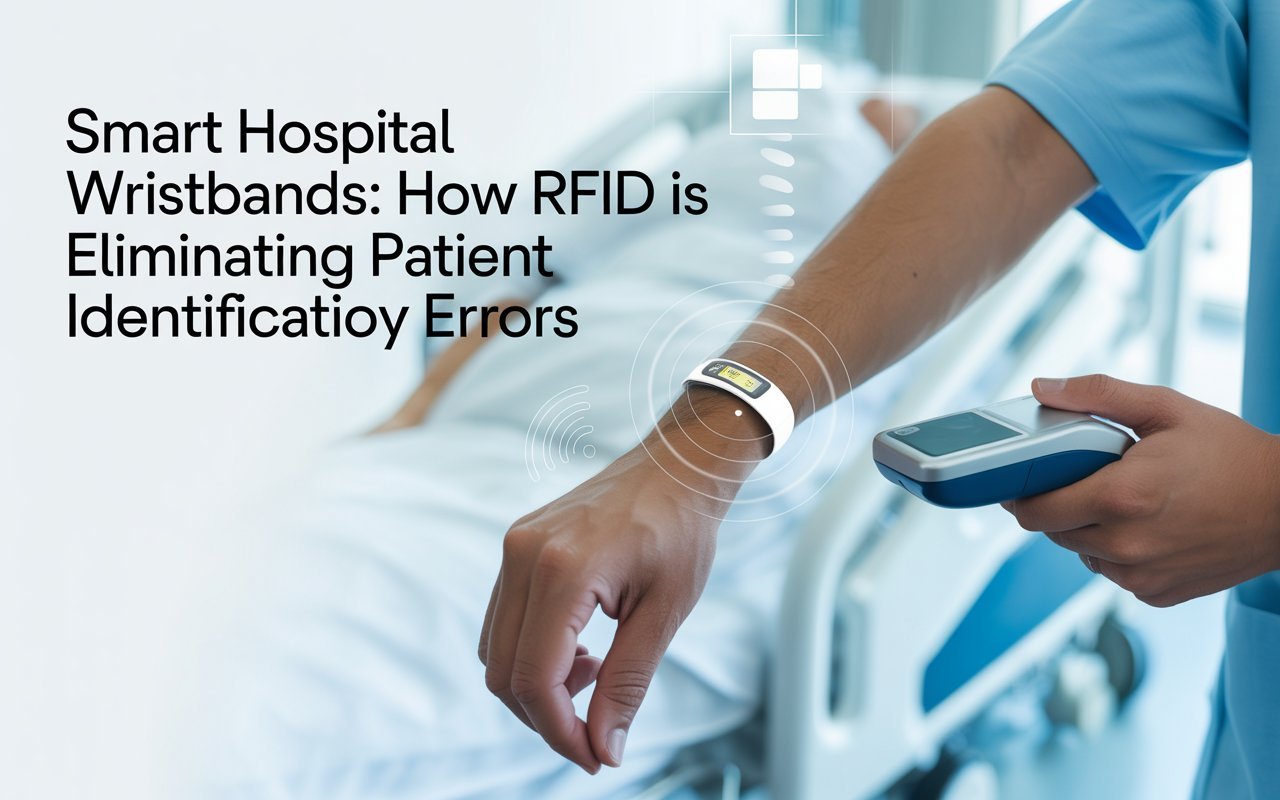
Smart Hospital Wristbands: How RFID Is Eliminating Patient Identification Errors in the UAE
The Silent Crisis in Hospital Wards That No One Talks About Enough
Every year, thousands of patients worldwide receive the wrong medication, undergo the wrong procedure, or get discharged with someone else’s medical records — not because of negligence, but because of a single, systemic flaw: unreliable patient identification.
In busy emergency wards, multi-specialty hospitals, and intensive care units across the UAE, nurses and doctors often manage dozens of patients simultaneously. A misread name on a paper wristband, a smudged barcode, or a handwritten label that faded during a shift — these are not rare edge cases. They are daily operational risks.
The UAE’s healthcare sector, which includes over 160 hospitals in Dubai alone and serves millions of residents and medical tourists annually, has set an ambitious standard: zero patient identification errors. Achieving that standard has brought one technology to the center of every smart hospital conversation — RFID-enabled hospital wristbands.
This article walks you through everything healthcare administrators, procurement professionals, and clinical directors need to know about smart hospital wristbands, how RFID works within them, why the UAE is leading adoption across the GCC, and how facilities can implement this technology without disrupting care workflows.
What Are Hospital Patient ID Wristbands?
A hospital patient ID wristband is a physical band worn on a patient’s wrist that carries identifying information used throughout their care journey. It acts as the primary link between a human patient and their electronic medical record (EMR), medication orders, lab results, imaging requests, and discharge documentation.
Traditional hospital wristbands used printed text and basic barcodes. A nurse would scan the barcode before administering medication or drawing blood, and the system would confirm the match. This process worked reasonably well — until barcodes got wet, torn, or misaligned. Until patients were unconscious and could not verbally confirm identity. Until the scanner was in the wrong room and the workflow broke down.
RFID-enabled hospital wristbands solve these problems by embedding a microchip and antenna directly into the wristband material. This chip stores and transmits patient data wirelessly, without requiring line-of-sight scanning or physical contact. The result is a patient identification system that works even when barcodes fail.
In the UAE context, smart hospital wristbands are also integrated with national health identity systems, insurance verification platforms, and in some cases, the UAE Pass digital identity infrastructure — creating an end-to-end, verified patient journey from admission to discharge.
The Core Technology: What Makes RFID Wristbands Different
How RFID Works in a Clinical Setting
RFID stands for Radio Frequency Identification. An RFID hospital wristband contains three core components:
The Microchip stores the patient’s unique hospital ID number, admission date, care unit, allergy flags, and sometimes blood type. The chip itself holds anywhere from a few kilobytes to several megabytes of data depending on the band specification.
The Antenna is a thin coiled wire embedded in the wristband that picks up radio signals from RFID readers. When a reader sends out a radio frequency signal, the antenna harvests enough energy to power the chip and transmit a response — all without a battery.
The Enclosure is the wristband itself, typically made from medical-grade silicone, Tyvek, or polyester. UAE hospitals prefer materials that are waterproof, latex-free, tamper-evident, and skin-safe for prolonged wear across multi-day admissions.
Passive vs. Active RFID in Hospital Settings
Not all RFID wristbands operate the same way. The choice between passive and active RFID affects both functionality and cost.
Passive RFID wristbands have no internal power source. They activate only when within range of an RFID reader — typically 1 to 10 centimeters for high-frequency (HF) systems used in hospitals. These are cost-effective, lightweight, and ideal for patient identification at medication stations, lab counters, and admission desks.
Active RFID wristbands contain a small battery and continuously broadcast a signal. They are detectable from distances of up to 100 meters and allow real-time location tracking of patients within the hospital. These are used in memory care units, pediatric wards, and high-security clinical zones where patient movement monitoring is a safety priority.
Most UAE hospitals deploying smart wristband systems use passive HF RFID for identification accuracy and active RFID for location-sensitive units — combining both technologies within a single patient care infrastructure.
Hospital Wristband Codes: What the Data Means
Decoding Hospital Patient ID Wristband Information
When a patient is admitted to a UAE hospital, their wristband is generated and encoded within minutes of registration. The information embedded in the wristband — whether via barcode, QR code, or RFID chip — follows a structured data format aligned with HL7 FHIR standards used in interoperable health systems.
A typical hospital wristband code contains:
- Patient MRN (Medical Record Number): A unique facility-level identifier that links to the full EMR
- Full Legal Name: Pulled from Emirates ID or passport for expatriate patients
- Date of Birth: Used as a secondary verification point at every clinical touchpoint
- Admission Date and Ward: Real-time care location reference
- Allergy Alerts: Color-coded flags — red for severe, yellow for moderate
- Blood Type: Critical for surgical and emergency scenarios
- Attending Physician: Department and named clinician reference
- Insurance or Billing Reference: Relevant for DHA-regulated facilities in Dubai
For RFID-enabled wristbands, all of this data is stored on the chip and can be updated in real time by authorized clinical staff using handheld readers or bedside terminals — without replacing the physical wristband.
Color-Coded Wristband Standards in UAE Hospitals
Beyond data encoding, the physical color of a hospital wristband carries clinical meaning. While there is no single mandated UAE-wide color standard, most Joint Commission International (JCI)-accredited facilities follow a common framework:
- White: Standard patient identification
- Red: Allergy alert — requires verification before any medication or procedure
- Yellow: Fall risk — triggers specific patient handling protocols
- Pink: Restricted extremity — used for patients where blood draws or IVs on a limb are prohibited
- Purple: Do Not Resuscitate (DNR) — requires signed documentation before issuance
- Green: Latex allergy — alerts environmental services and surgical teams
Smart RFID wristbands encode these flags digitally, reducing the risk that a physical color is overlooked in low-light clinical environments or during shift handovers.
Why UAE Hospitals Are Fast-Tracking RFID Wristband Adoption
The Regulatory Momentum
The UAE’s healthcare regulators — including the Dubai Health Authority (DHA), the Health Authority Abu Dhabi (HAAD/DoH), and the Ministry of Health and Prevention (MOHAP) — have been pushing digital transformation across the sector through initiatives like the Dubai Health Strategy 2021–2026 and the Abu Dhabi Healthcare Information and Cyber Security Standard (ADHICS).
Patient safety, data integrity, and interoperability are central to these frameworks. RFID wristbands directly address all three: they reduce human error in patient identification, maintain data accuracy across care transitions, and connect to shared EMR platforms like Salama (Abu Dhabi) and the DHA’s Nabidh system.
Hospitals seeking or maintaining JCI accreditation — a gold standard widely pursued in UAE private healthcare — must demonstrate robust patient identification protocols. RFID wristbands have become one of the clearest, most auditable ways to do this.
The Medical Tourism Factor
The UAE received over 1.2 million medical tourists in 2023, according to Dubai Tourism data. These patients arrive from across the GCC, South Asia, Europe, and Africa — often speaking different languages, unfamiliar with local hospital environments, and unable to verbally confirm their identity reliably in clinical contexts.
For this patient population, RFID hospital wristbands eliminate the language barrier entirely. The chip doesn’t care what language the patient speaks. The reader doesn’t need the patient to respond. Identity verification becomes a silent, seamless, system-to-system transaction.
Real-World Use Cases: Where Smart Wristbands Deliver the Most Value
1. Medication Administration Safety
The most common and highest-impact use case. A nurse approaches a patient bed with a medication cart. Before administering any drug, she scans the patient’s RFID wristband with a handheld reader. The bedside system cross-references the patient ID against the medication order, checks for allergy conflicts, verifies the correct dose, and confirms the administration window. The entire process takes under three seconds and is logged automatically in the EMR.
Without RFID, this same check requires the nurse to manually read the wristband, verbally ask the patient to confirm their name, and manually document the administration. Each manual step introduces failure points. RFID removes them.
2. Surgical Site and Patient Verification
Wrong-site surgery remains one of the most severe never-events in global healthcare. UAE hospitals use RFID wristbands as part of a multi-layer surgical timeout protocol. When a patient enters the operating theatre, their wristband is scanned against the surgical schedule, the consent documentation, and the surgical team’s system credentials — creating a verified digital chain of custody before any incision.
3. Newborn and Pediatric Identification
Neonatal wards present a specific identification challenge: infants cannot speak, look similar, and are often moved between rooms for feeding, testing, and care. UAE maternity hospitals use matched RFID wristband sets — one on the infant’s ankle, one on the mother’s wrist — that generate an alert if the two bands are separated beyond a defined proximity threshold. This both prevents baby mix-ups and acts as an infant security system.
4. Patient Flow and Bed Management
Active RFID wristbands allow hospital operations teams to monitor patient locations in real time through indoor positioning systems (IPS). This data feeds directly into bed management software, allowing administrators to see which beds are occupied, which patients are in transit to radiology or physiotherapy, and where bottlenecks are forming in high-demand departments. For UAE hospitals managing thousands of patients daily, this operational intelligence translates directly into cost savings and shorter wait times.
5. ICU and High-Dependency Unit Monitoring
In intensive care, patients are frequently sedated, intubated, or otherwise unable to communicate. RFID wristbands ensure that every clinical interaction — from medication rounds to ventilator adjustments — is automatically verified against the correct patient record. In the event of a code blue or rapid deterioration, responding clinicians can instantly pull up the full patient profile by scanning the wristband, without waiting for manual record lookup.
6. Emergency Department Triage
UAE emergency departments in major cities like Dubai and Abu Dhabi are among the busiest in the region, handling trauma cases, road accident victims, and acute medical emergencies simultaneously. At triage, an RFID wristband is generated and encoded within 60 seconds of patient arrival. From that moment, every test, every treatment, and every consultation is linked to that wristband — creating a real-time, auditable emergency care record even for unconscious or unidentified patients.
Key Features to Look for in Hospital Patient ID Wristbands
Procurement teams evaluating RFID wristband solutions for UAE healthcare facilities should assess vendors across these dimensions:
Chip Specification and Read Range: ISO 15693 (HF) and ISO 18000-6C (UHF) are the dominant standards. HF is preferred for close-range patient ID; UHF is suitable for asset and patient tracking at longer ranges.
Material and Comfort: Medical-grade silicone is the preferred material for extended wear. Bands must be latex-free, hypoallergenic, and comfortable for pediatric, geriatric, and bariatric patient populations.
Tamper Evidence: The wristband must be single-use with a clear visual tamper indicator. If a band is cut and replaced, the system should log the event and require re-verification.
Water and Chemical Resistance: Hospital environments involve frequent hand washing, patient bathing, IV administration, and cleaning protocols. The wristband must remain fully functional and legible through all of these.
Printing Compatibility: Most RFID wristbands also carry printed information — patient name, MRN, barcode — as a backup identification layer. Thermal printing compatibility is standard; direct thermal printing without ribbons is preferred for workflow speed.
EMR Integration: The wristband system must integrate with the hospital’s existing EMR platform via HL7 FHIR APIs. In the UAE, compatibility with Nabidh (Dubai) and Malaffi (Abu Dhabi) health information exchanges is increasingly expected.
Battery Life (Active Systems): For active RFID bands used in location tracking, battery life of 12 to 36 months is the practical benchmark for most hospitals.
Implementation Overview: Deploying RFID Wristbands in a UAE Hospital
Phase 1: Infrastructure Assessment (Weeks 1–4)
Before a single wristband is ordered, the hospital’s existing IT and physical infrastructure must be evaluated. This includes mapping RFID reader placement across nursing stations, medication rooms, operating theatres, and ward entry points. The goal is to identify coverage gaps and determine whether the facility requires passive HF readers, active UHF readers, or a hybrid architecture.
Phase 2: EMR Integration and System Configuration (Weeks 4–10)
The wristband management software must be configured to communicate with the hospital’s EMR. This involves API development or middleware configuration, patient data mapping, and user access role setup. Clinical informatics teams work alongside the vendor to ensure that wristband scan events trigger the correct EMR workflows.
Phase 3: Staff Training and Protocol Development (Weeks 8–12)
Technology without protocol is ineffective. Clinical staff — nurses, pharmacists, lab technicians, surgical teams — must be trained on the new scanning workflows, the meaning of wristband flags, and escalation procedures when a wristband scan fails or returns an unexpected result. Training programs are typically delivered in clinical simulation environments before go-live.
Phase 4: Pilot Rollout (Weeks 12–16)
A controlled pilot in one or two wards allows the hospital to identify workflow friction, technical edge cases, and staff adoption challenges before facility-wide deployment. Data from the pilot — scan success rates, exception logs, staff feedback — informs final system adjustments.
Phase 5: Full Deployment and Continuous Monitoring (Month 4 Onward)
Full deployment is followed by ongoing monitoring through system dashboards that track scan compliance rates, wristband failure events, and integration error logs. Most UAE hospitals that have completed full deployment report scan compliance rates above 97% within three months of go-live.
RFID Wristbands vs. Traditional Barcoded Wristbands: A Practical Comparison
| Feature | Traditional Barcode Wristband | RFID Smart Wristband |
| Scan method | Line-of-sight required | Wireless, no line-of-sight |
| Scan distance | 5–30 cm with alignment | 1–100 m (passive/active) |
| Data capacity | Limited (numeric/alpha ID) | Kilobytes to megabytes |
| Real-time data update | Not possible | Possible via authorized readers |
| Performance when wet/dirty | Frequently fails | Unaffected |
| Patient location tracking | Not supported | Supported (active RFID) |
| EMR integration depth | Basic | Deep, bi-directional |
| Cost per unit | AED 1–5 | AED 15–80 depending on spec |
| JCI compliance support | Moderate | Strong |
The cost premium of RFID wristbands is real, but UAE hospitals consistently report that the reduction in adverse events, the improvement in staff efficiency, and the elimination of re-work from identification errors more than offset the per-unit price difference within the first year of deployment.
FAQ: Smart Hospital Wristbands and RFID Patient Identification
Q1: What information is stored on a hospital patient ID wristband in UAE hospitals?
UAE hospital wristbands store the patient’s Medical Record Number (MRN), full legal name, date of birth, blood type, allergy flags, admission ward, attending physician, and insurance reference. RFID-enabled wristbands store all of this data digitally on a microchip, while also displaying a printed version for manual backup verification. The data is linked in real time to the hospital’s EMR system, ensuring that any update to the patient’s record is immediately accessible at the point of care.
Q2: How do hospital wristband codes work during medication administration?
When a nurse is about to administer medication, they scan the patient’s wristband with an RFID or barcode reader. The system cross-references the patient’s unique ID with the active medication order in the EMR, verifies the drug name, dose, route, and timing, and checks the patient’s allergy profile. If everything matches, the system confirms and automatically logs the administration. If there is a discrepancy — wrong patient, wrong drug, wrong time — the system triggers an alert and prevents the error from proceeding.
Q3: Are RFID hospital wristbands safe for patients with medical implants?
RFID wristbands used in clinical settings operate at low-power radio frequencies — typically 13.56 MHz for HF systems — and have been evaluated for electromagnetic interference (EMI) with cardiac pacemakers, cochlear implants, and other active implantable medical devices (AIMDs). Major RFID wristband vendors certify their products as compliant with IEC 60601-1-2 electromagnetic compatibility standards. However, clinical staff are advised to follow facility-specific protocols for patients with known implants, which typically recommend maintaining a minimum distance between the reader and the implant site.
Q4: How do UAE hospitals handle RFID wristband data privacy under local regulations?
Patient data stored on RFID wristbands is encrypted and protected under the UAE’s Health Data Law and ADHICS standards. The wristband chip stores only the patient’s unique identifier — it does not store full medical records. The actual clinical data lives in the EMR, which is accessible only through authenticated clinical systems. Physical wristbands are classified as medical waste and disposed of through regulated health waste streams. Hospitals are required to maintain audit logs of all wristband read events, which are subject to DHA and DoH inspection during accreditation reviews.
Q5: Can RFID wristbands be used to track patient location inside the hospital?
Yes, but this requires active RFID technology rather than passive RFID. Active RFID wristbands contain a small battery and continuously transmit a signal that is picked up by ceiling-mounted or wall-mounted readers throughout the facility. This allows the hospital’s real-time location system (RTLS) to display patient positions on a digital floor map. This capability is particularly valuable in memory care units, pediatric wards, and large multi-building hospital campuses. UAE facilities using active RFID for patient tracking are required to inform patients about the monitoring as part of their admission consent process.
Q6: What is the typical lifespan of an RFID hospital wristband?
Passive RFID hospital wristbands are designed as single-use disposables. Their intended lifespan covers the full duration of a patient’s admission — typically 3 to 14 days for most inpatient stays. The materials are engineered to remain water-resistant, readable, and physically intact throughout that period even under daily clinical conditions. If a wristband is damaged or removed for any reason, replacement protocols require re-verification of the patient’s identity through a secondary method before a new band is issued and encoded.
Q7: How do RFID wristbands support newborn safety in UAE maternity hospitals?
Newborn safety programs in UAE maternity hospitals use matched RFID wristband sets. The infant receives an RFID ankle band at birth, while the mother receives a matching RFID wrist band. The two bands are encoded with a shared unique identifier that links them in the hospital system. If the infant is moved outside a defined proximity range from the mother’s band — or if either band is tampered with — the system generates an immediate alert to nursing staff and security. Some facilities also integrate the bands with door-locking systems that prevent unauthorized exit from the maternity floor.
Who Supplies RFID Hospital Wristbands in the UAE?
The UAE market is served by a mix of global manufacturers and regional distributors. Key vendors active in the GCC healthcare space include:
Brady Corporation — one of the most widely used providers of hospital wristband printing systems in UAE facilities, offering both standard barcode and RFID-enabled wristband solutions with thermal printing compatibility.
Zebra Technologies — supplies both RFID wristbands and the handheld readers used at bedside and nursing stations. Their healthcare-specific RFID portfolio is widely deployed in JCI-accredited private hospitals.
PDC BioTech — specializes in infection-control-grade wristband materials, particularly relevant in post-COVID UAE hospital environments where hygiene standards have been elevated permanently.
Alien Technology and Impinj — both supply the RFID chips embedded in wristbands used by the above manufacturers. Impinj’s RAIN RFID platform is particularly common in UAE hospital infrastructure deployments.
Regional distributors such as Oman-based Gulf Medical and Dubai-based IDAM Healthcare have established local supply chains that reduce lead times and provide on-ground technical support during implementation.
Conclusion: The Case for RFID Wristbands Is No Longer a Question of If, But When
The UAE has made its direction clear. Smart hospitals are not a future state — they are the current benchmark for any facility seeking to compete at the level that patients, regulators, and accreditation bodies now expect.
RFID-enabled hospital patient ID wristbands sit at the center of this transformation. They close the identification gap that traditional barcodes and paper processes leave open. They create a verified, real-time, system-linked connection between every patient and every clinical decision made on their behalf. And in a healthcare market that spans millions of residents and medical tourists from across the globe, they do this silently, consistently, and without needing the patient to do anything at all.
The question facing healthcare administrators and procurement leaders in the UAE today is not whether to adopt RFID wristbands — the clinical evidence, the regulatory momentum, and the operational case are all settled. The question is how to implement them in a way that integrates cleanly with existing EMR infrastructure, trains clinical staff effectively, and delivers measurable outcomes within the first year.
Facilities that move decisively on this technology will not only reduce adverse events — they will build a patient safety infrastructure that becomes a competitive differentiator in the region’s growing medical tourism market, a compliance asset in JCI reviews, and a foundation for the broader digital health capabilities that the UAE’s most ambitious hospitals are building right now.