

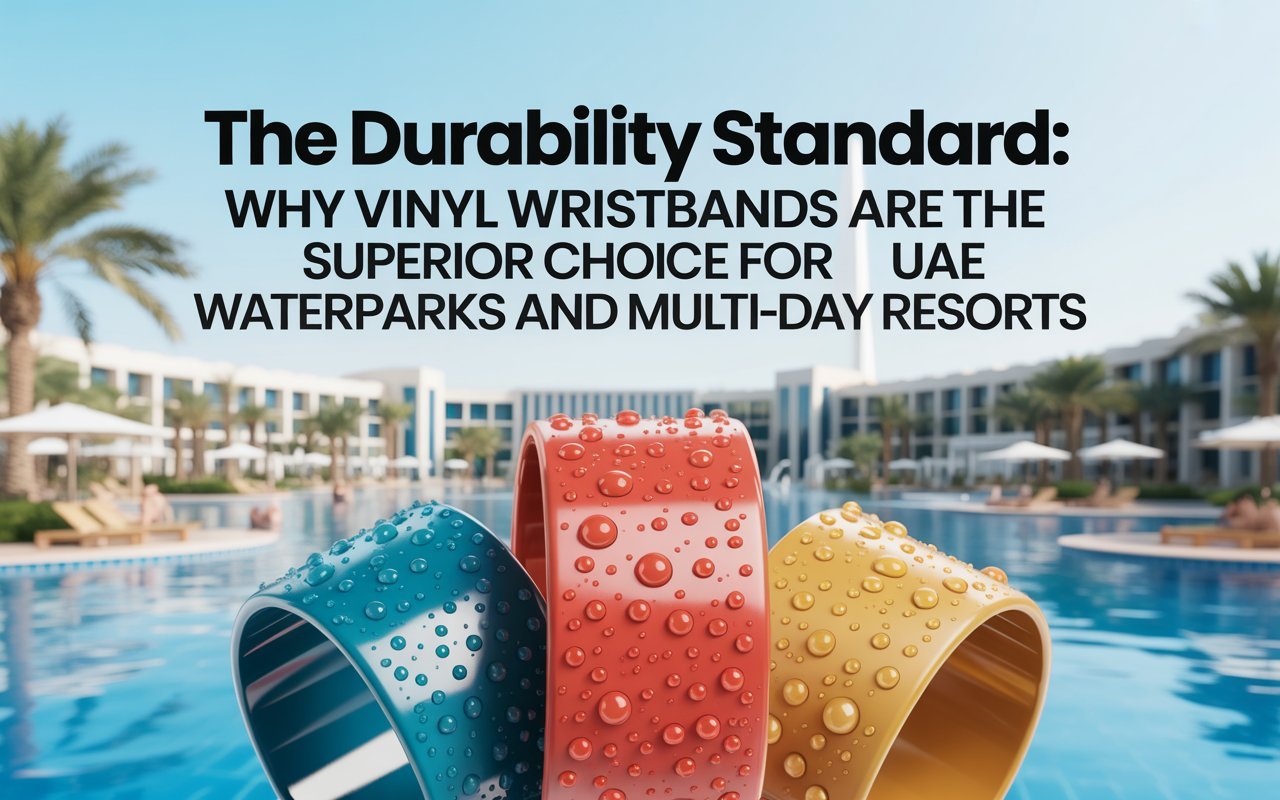
The Durability Standard: Why Vinyl Wristbands Are the Superior Choice for UAE Waterparks and Multi-Day Resorts
The Problem Waterparks and Resorts Face in the UAE
Every season, waterpark operators and resort managers across the UAE face the same invisible crisis — wristbands that fail before the guest experience does.
The United Arab Emirates hosts some of the world’s most demanding leisure environments. Outdoor temperatures regularly exceed 45°C between May and September. Chlorinated wave pools, saltwater lazy rivers, waterslide runoffs, sunscreen residues, and the constant friction of continuous wristband wear from check-in to checkout create conditions that most identification solutions were simply never designed to survive.
Venues like Yas Waterworld in Abu Dhabi, Aquaventure at Atlantis The Palm, and Laguna Waterpark at La Mer Dubai handle tens of thousands of guests on peak days. At this scale, wristband failure is not a minor inconvenience. When an identification band deteriorates after a few hours of water contact, it creates queuing chaos at entry checkpoints, enables fraudulent re-entry, increases staff intervention time, and fundamentally weakens the access control layer that operators depend on.
The same challenge extends beyond single-day waterparks into multi-day resort stays. A beach resort in Jumeirah expects a guest to wear an access band for three, five, or even seven consecutive nights and days — through morning swims, evening spa visits, and everything between. Paper-based alternatives dissolve. Fabric options absorb chlorine and develop odour. The identification band must remain intact, legible, and tamper-resistant for the duration.
Key operational figures UAE operators deal with:
| 48°C
UAE peak ambient temp |
3–7 Days
Continuous resort wear |
40,000+
Daily guests at major parks |
100%
Waterproof requirement |
The solution that event access professionals, operations directors, and guest experience managers consistently return to is the vinyl wristband. This article explains exactly why — and what you need to know before specifying them for your operation.
What Are Vinyl Wristbands?
Vinyl wristbands are single-use or limited-reuse identification and access control bands manufactured from polyvinyl chloride — commonly known as PVC — a synthetic thermoplastic polymer. Unlike Tyvek wristbands (which use spun-bonded polyethylene) or traditional paper stock, vinyl wristbands are constructed from a material that is fundamentally impermeable to water and resistant to physical degradation under humid, UV-exposed, and chemically active conditions.
The standard vinyl wristband is a flat, flexible strip — typically 25mm wide and available in adult and child lengths — fitted with a one-way snap closure mechanism. Once applied and snapped shut, the band cannot be removed without cutting, providing a reliable indicator of original issuance.
From a materials science standpoint, PVC’s molecular chain structure gives it a combination of properties that are exceptionally well-suited to the leisure and hospitality sector. It resists aqueous solutions and many organic solvents, maintains dimensional stability across a wide temperature range, and accepts dye sublimation, thermal transfer, and direct thermal printing on its surface without the ink bleeding or fading that occurs on porous paper alternatives.
In the UAE market, vinyl wristbands are supplied in two formats. The first is pre-printed — produced at the factory with event branding, colour-coded date systems, or venue logos applied before delivery. The second is blank stock — printed on-site at check-in kiosks using compatible wristband printers. Both supply models are in active use across the country’s hospitality infrastructure.
| Quick definition for buyers: A vinyl wristband is a PVC-based, waterproof, snap-closure identification band designed for extended wear in wet, UV-exposed, or high-contact environments — the category standard for waterparks, beach resorts, spas, multi-day festivals, and aquatic facilities worldwide. |
Core Attributes and Technical Features of Vinyl Wristbands
Understanding why vinyl wristbands perform so well in demanding environments requires examining their technical attributes individually. Each property addresses a specific operational challenge that waterpark managers and resort operators encounter on the ground.
Complete Waterproofing and Chemical Resistance
PVC does not absorb water. Unlike Tyvek, which is water-resistant but not waterproof, and fabric, which becomes saturated and holds both moisture and chlorine residue, vinyl repels water at the molecular level. A vinyl wristband applied at 8am will look and function identically at 8pm after twelve hours of pool submersion, waterslide use, and repeated towel friction.
Beyond pure water resistance, vinyl withstands dilute chlorine concentrations typical of commercial swimming pools (1–3 ppm free chlorine), salt water, sunscreen oils, and brief contact with cleaning products used in resort housekeeping. This chemical robustness is critical in environments where incidental chemical contact is unavoidable.
Tamper-Evident, Non-Transferable Closure
The one-way snap closure on vinyl wristbands — sometimes called a ‘security snap’ or ‘ratchet closure’ — is engineered to be irreversible without physical destruction of the band. Once the male tab is engaged with the female locking mechanism, it cannot be manipulated open without visible deformation of the closure or severing of the band itself.
This property is operationally significant for waterpark access control. A guest who removes a wristband to pass it to a non-paying visitor cannot do so without the band showing visible tampering. Gate staff can identify transferred or manipulated bands with a quick visual check, eliminating one of the most common revenue leakage vectors in high-volume attractions.
Print Surface Quality and Barcode Legibility
Modern vinyl wristbands accept thermal transfer and inkjet printing with high resolution and sharp edge definition. Barcodes, QR codes, sequential numbering, and photographic-quality logos can all be printed onto the vinyl surface with sufficient clarity for barcode scanner reads — including wet-environment scans where the band surface may carry water droplets.
The non-porous surface of vinyl prevents ink bleed, a chronic problem with paper and Tyvek alternatives where humidity causes ink to spread laterally through the material’s fibres. On vinyl, ink sits on the surface, dries completely, and remains legible for the duration of the band’s intended use life.
UV Stability
Outdoor resort environments in the UAE expose every wristband to intense ultraviolet radiation for prolonged periods. PVC formulations used in wristband manufacturing typically include UV stabilisers — chemical additives that absorb or reflect UV energy before it can break polymer chains and cause colour fading or physical embrittlement. A quality vinyl wristband will maintain its printed colour and structural integrity through a full day of direct UAE sun exposure without fading, cracking, or becoming brittle.
Comfort and Skin Compatibility
Vinyl is flexible and conforms to the shape of the wrist without creating pressure points. Medical-grade PVC formulations — which many wristband manufacturers have adopted — are specifically engineered to minimise the risk of skin irritation during extended wear. For guests wearing bands continuously for multiple days, the smooth, non-abrasive surface of vinyl causes significantly less friction discomfort than fabric weave alternatives or the stiff edges of some Tyvek products.
Colour-Coded Access Management
Vinyl wristbands are available in a wide palette of base colours, enabling operationally significant colour-coding systems. A resort might use blue for day guests, green for hotel guests with pool access, orange for VIP cabana bookings, and red for under-12 guests. This visual differentiation allows trained staff to perform access validation at a glance, reducing checkpoint delays and improving throughput at high-traffic entry points.
Summary of core features:
- Extended wear life of 3 to 7 days without structural degradation
- Tamper-evident one-way snap that shows clear physical signs of removal attempts
- Full waterproofing across pool water, saltwater, and chemical cleaning environments
- Barcode and QR code compatibility for scanner-readable access management
- UV stabilisation to resist fading and embrittlement under direct UAE sunlight
- Smooth, flexible PVC that minimises friction during extended multi-day wear
Use Cases, Industries Served, and Real-World Applications
Vinyl wristbands are not a single-application product. Their combination of durability, print quality, and tamper resistance makes them the default specification across a wide range of sectors operating in the UAE and across the broader GCC region.
Waterparks and aquatic attractions represent the primary use case. Vinyl bands handle guest identification, zone access control, locker assignment, and food and beverage charging integration simultaneously. They are the category standard for wave pools, lazy rivers, and waterslide complexes.
Beach resorts and hotel pools use vinyl for multi-day stay bands with date coding. The band distinguishes hotel guests from day visitors and integrates with all-inclusive beverage systems — critical for resorts where pool access is a ticketed add-on for non-resident guests.
Spas and wellness centres rely on vinyl for locker assignment and treatment-tier identification. Vinyl resists steam room humidity, swimming pool submersion between treatments, and towel friction in a way that paper alternatives simply cannot.
Multi-day outdoor festivals including outdoor camping events and music weekends use vinyl for weekend passes that must survive rain, dust, UV exposure, and continuous 72-hour wear. The same festivals that experimented with Tyvek for multi-day passes have overwhelmingly migrated to vinyl after experiencing the degradation that occurs on day two.
Cruise terminals and marine experiences — dhow cruises, catamaran tours, and diving vessels operating in the Gulf — require saltwater-resistant identification for every passenger. Vinyl is the only paper-format wristband that genuinely withstands salt water without delamination or closure failure.
Children’s entertainment venues use vinyl for parent-child matching systems in theme parks and indoor play areas. Hospital patient identification represents a growing application in clinical environments requiring waterproof, non-tearable patient banding — particularly paediatric wards and ICU settings where bands are subject to repeated sanitisation.
Real-World Scenario: A UAE Waterpark at Capacity
Consider a large waterpark operating in Dubai during July. At opening time, the admissions team issues vinyl wristbands printed with the current date, a unique sequential number, and a QR code tied to the guest’s locker assignment and any pre-purchased food credit.
Over the following eight hours, each band is submerged in wave pool water dozens of times, rubbed against waterslide surfaces, covered in sunscreen, and worn through a buffet lunch. At closing, gate staff scan each band for validation. The print must still be machine-readable. The snap must still be intact. The colour coding must still be visually legible from three metres away.
Vinyl wristbands meet every one of these requirements. The alternatives — Tyvek, fabric, paper — do not meet all of them simultaneously.
Vinyl vs. Tyvek vs. Fabric: The Full Comparison
The wristband selection decision ultimately comes down to three main material categories. Each has genuine strengths — the comparison below provides an honest assessment of how they perform across the dimensions that matter most to UAE waterpark and resort operators.
| Performance Criterion | Vinyl (PVC) | Tyvek | Fabric / Woven |
| Water resistance | Fully waterproof | Water-resistant only | Absorbs water |
| Chlorine resistance | Excellent | Degrades over time | Retains chlorine smell |
| Tamper resistance | One-way security snap | Adhesive closure | Woven closure |
| Multi-day wear suitability | 3–7 days | Single day only | Multiple days |
| Print resolution (barcode/QR) | High — non-porous surface | Medium — ink bleed risk | Low — not smooth |
| UV resistance | UV-stabilised | Moderate | Variable by dye type |
| Unit cost | Medium | Low | High |
| Cost per guest-day (multi-day) | Lowest — one band, multiple days | Highest — daily replacement | Medium |
| Skin comfort (extended wear) | Smooth, flexible | Stiff edges possible | Soft, breathable |
| RFID / NFC integration | Compatible | Generally incompatible | Compatible |
| Key insight for multi-day resort operators: Although vinyl wristbands carry a higher unit cost than Tyvek, a resort issuing Tyvek bands must replace them daily. A guest staying three nights requires three Tyvek bands — often four or five if early degradation occurs. A single vinyl band covers the entire stay. The per-guest-day cost of vinyl is consistently lower when wear periods exceed 36 hours. |
Where Tyvek Still Has a Place
Tyvek wristbands are not obsolete. They remain the right choice for single-day dry events: concerts, sporting fixtures, corporate daytime events, and indoor exhibitions where there is no water exposure and guests will discard the band at the end of the day. Their lower unit price and ease of bulk logistics make them practical for very high-volume, short-duration applications. The distinction is simple — when water is involved, or when wear duration exceeds twelve hours, Tyvek is the wrong specification.
Where Fabric Wristbands Compete
Fabric wristbands are best suited to multi-day music festivals and events where brand identity and guest keepsake value are as important as access control. A luxurious woven festival band with a signature clasp is a collectible. A vinyl band is an access credential. For resort operations where professional access management is the primary objective, fabric’s higher cost, lower print resolution, and reduced security snap reliability make it a secondary choice.
Performance Benchmark
The table below summarises how vinyl wristbands compare against Tyvek and fabric across six critical operational metrics, scored out of 10 and reflecting real-world performance in UAE waterpark and resort conditions.
| Metric | Vinyl | Tyvek | Fabric |
| Water resistance | 10 / 10 | 5 / 10 | 4 / 10 |
| Tamper resistance | 9 / 10 | 6 / 10 | 7 / 10 |
| Print durability | 9 / 10 | 5 / 10 | 6 / 10 |
| Skin comfort | 8 / 10 | 6 / 10 | 9 / 10 |
| Reuse potential | 7 / 10 | 2 / 10 | 8 / 10 |
| Cost efficiency (multi-day) | 8 / 10 | 9 / 10 | 5 / 10 |
| “In a waterpark operating at capacity, wristband failure is a guest experience failure. Vinyl removes that variable entirely.” |
Implementation Overview for UAE Operators
Specifying vinyl wristbands correctly for your operation involves more than selecting the right material. The following is a practical overview of the implementation decisions that determine whether your wristband programme succeeds operationally.
Step 1 — Define Your Access Control Requirements
Determine how many access zones your venue has, whether you need zone differentiation through colour coding, and whether barcodes or QR codes will integrate with your entry management software. This determines both the wristband specification and the printer configuration required at check-in.
Step 2 — Select the Right Wristband Specification
Standard vinyl wristbands come in 25mm width with adult (approximately 260mm) and child (approximately 195mm) lengths. For multi-day resort use, opt for PVC formulations with UV stabilisers and medical-grade plasticisers. For waterparks, confirm the supplier’s chlorine resistance rating against your facility’s pool concentration.
Step 3 — Choose Between Pre-Printed and On-Demand Printing
Pre-printed wristbands reduce check-in time but require advance ordering and offer less per-guest customisation. On-demand printing at arrival kiosks allows sequential numbering, guest name printing, date coding, and barcode generation — but requires investment in compatible thermal transfer wristband printers and trained staff to operate them.
Step 4 — Configure Your Colour-Coding System
Assign specific colours to stay types, access tiers, or date codes. Document this system in staff training materials and ensure all entry-point personnel understand the visual validation protocol. Laminated quick-reference cards at each checkpoint reduce errors during peak capacity periods.
Step 5 — Train Staff on Correct Application and Visual Validation
The most common operational failure in wristband programmes is not product failure — it is incorrect application. Staff must be trained to apply the snap securely but not uncomfortably tightly, to apply the band to the correct wrist, and to perform a visual check of snap integrity at secondary entry points.
Step 6 — Establish Reorder Thresholds and Supplier Relationships
UAE-based suppliers can typically fulfil standard vinyl wristband orders within three to seven business days for blank stock, with two to four weeks for customised pre-printed orders. Establish a reorder point that keeps a rolling buffer of at least two weeks’ peak supply at all times — particularly before Eid holidays and the October–April tourist high season.
RFID and NFC Integration
An increasing number of UAE waterparks and resorts are integrating RFID chips or NFC modules into vinyl wristbands, enabling cashless payment, ride booking, locker control, and photography package access from a single wristband. The vinyl substrate is fully compatible with embedded chip technology — the chip and antenna are sealed within the wristband body, protected from water by the surrounding PVC. This technology is commercially deployed at several leading UAE attractions and represents the direction of the sector’s next generation of access management.
Frequently Asked Questions
The following questions reflect the most common queries from procurement managers, operations directors, and event coordinators when evaluating vinyl wristbands for UAE waterpark and resort applications.
Q: How long do vinyl wristbands last in UAE waterpark conditions — including direct sun, chlorine, and high heat?
Quality vinyl wristbands manufactured from UV-stabilised PVC are designed to maintain structural integrity and print legibility for a minimum of seven days of continuous wear under conditions typical of UAE waterparks — including daily pool submersion, chlorine exposure at standard recreational pool concentrations of 1–3 ppm free chlorine, ambient temperatures up to 50°C, and direct UV exposure. In practice, most operators find that the bands outlast their intended wear period with no meaningful degradation. The most common reason a vinyl wristband is replaced early is accidental cutting during first aid or a guest request — not material failure. Testing your specific supplier’s product under your pool’s exact chlorine concentration before large-scale specification is always advisable.
Q: What is the difference between vinyl wristbands and Tyvek wristbands, and which is better for a multi-day beach resort?
Tyvek is a spun-bonded polyethylene material — a type of synthetic paper with excellent tear resistance but limited water resistance. When submerged or repeatedly wetted, Tyvek softens, loses its snap adhesion, and the printed ink becomes susceptible to smearing. It is a single-day product. Vinyl is a fully waterproof thermoplastic that repels water entirely, resists chlorine and salt water, and maintains print quality through continuous wet exposure. For a beach resort where guests wear bands in the pool, at the beach, in the spa, and during evening dining — for two, three, or more consecutive days — vinyl is unequivocally the correct specification. Tyvek would need replacing daily, which eliminates its unit-cost advantage and creates significant operational friction.
Q: Can vinyl wristbands be printed on-site? What printers are compatible?
Vinyl wristbands can be printed on-site using dedicated wristband printers, and this is the preferred setup for operations requiring per-guest customisation, sequential numbering, date coding, or barcode and QR code generation at check-in. Compatible printer technologies include direct thermal (prints by heating the wristband surface, no ink required — limited to monochrome output) and thermal transfer (uses a ribbon to transfer ink to the vinyl surface — supports colour printing and higher resolution). Leading wristband printer brands compatible with vinyl media include Brady, Zebra Technologies, Boca Systems, and Seiko. When selecting a printer, confirm that the vinyl wristband stock is certified compatible with your chosen model.
Q: Are vinyl wristbands safe for guests with sensitive skin or latex allergies?
Standard vinyl wristbands are latex-free, as PVC and natural rubber latex are entirely different materials. Medical-grade PVC formulations — which many reputable wristband manufacturers use — are specifically engineered to minimise plasticiser migration and reduce the risk of dermal sensitisation during extended wear. If your operation serves guests with known chemical sensitivities, enquire with your supplier about phthalate-free or DEHP-free PVC formulations, which comply with EU REACH regulations for skin contact materials. Adverse skin reactions to quality vinyl wristbands are uncommon in the general population.
Q: How do vinyl wristbands support RFID and cashless payment systems in UAE resorts?
RFID-enabled vinyl wristbands incorporate a small electronic chip and antenna sealed within a protected pocket inside the wristband body. The vinyl enclosure is waterproof, protecting the chip from pool water, sweat, and mechanical stresses of normal wear. These bands communicate at either 125 kHz for simple access control or 13.56 MHz (the NFC standard) for payment, ride booking, and photo collection integration. Major access management platforms used by UAE attractions — including systems integrated with Oracle OPERA, Infor HMS, and bespoke attraction management software — support RFID wristband integration. The wristband becomes the guest’s single credential for room access, pool access, food and beverage charging, locker opening, and souvenir photo retrieval.
Q: What is the minimum order quantity for custom-printed vinyl wristbands in the UAE?
For blank vinyl wristbands in standard colours, most UAE-based distributors carry stock fulfillable immediately or within 48 hours, with no minimum order quantity. For custom-printed vinyl wristbands incorporating your venue’s logo, Pantone-matched colours, or sequential numbering ranges, minimum orders typically start at 500 to 1,000 units. Production and shipping lead time from regional suppliers is typically 7–14 business days for standard custom orders. For the UAE’s peak tourism season (October to April) and major holiday periods, placing orders 6–8 weeks in advance is strongly advisable.
Q: How can waterpark operators reduce wristband fraud using vinyl wristbands?
Vinyl wristbands address fraud through three converging mechanisms. First, the one-way security snap makes physical transfer without visible damage impossible — trained staff can identify snaps showing signs of manipulation. Second, on-site printed barcodes or QR codes can be programmed as single-scan credentials in your access management software, so each code is invalidated after the first gate scan. Third, date-coded colour systems mean yesterday’s colour is visually identifiable to any staff member, even without a scanner. The combination of physical tamper evidence, digital validation, and colour coding creates a three-layer fraud deterrent that no paper alternative can match.
Final Verdict
The UAE’s hospitality and leisure sector operates at the extreme end of the environmental performance spectrum. Ambient heat, intense UV radiation, chlorinated water, salt air, and the extended wear demands of multi-day resort stays create a combination of stresses that will defeat any wristband solution that has not been specifically engineered to handle them.
Vinyl wristbands, manufactured from UV-stabilised PVC with tamper-evident snap closures and high-resolution print surfaces, are the product category that meets every one of these demands simultaneously. They are the only wristband type that is fully waterproof, multi-day capable, barcode-legible after pool submersion, and structurally tamper-resistant — all at once.
The cost argument, which sometimes leads procurement teams toward cheaper Tyvek alternatives, does not survive honest analysis in multi-day resort environments. When calculated on a per-guest-day basis over a three-night stay, vinyl is consistently the most cost-efficient option because a single band covers the entire stay. The operational burden of daily Tyvek replacement — staff time, guest friction, daily re-issuing processes, and the brand experience cost of a guest whose band disintegrated on day two — adds costs that never appear in the per-unit comparison.
For waterpark operators, the argument is even simpler: there is no credible alternative. A wristband that fails in a wave pool is a wristband that has failed at its primary function. Vinyl does not fail in wave pools.
Whether you are specifying bands for a new waterpark opening, upgrading an existing resort’s access management system, or planning a multi-day outdoor event in the UAE’s demanding outdoor season, vinyl wristbands represent the durability standard against which every alternative should be measured — and most will fall short.