

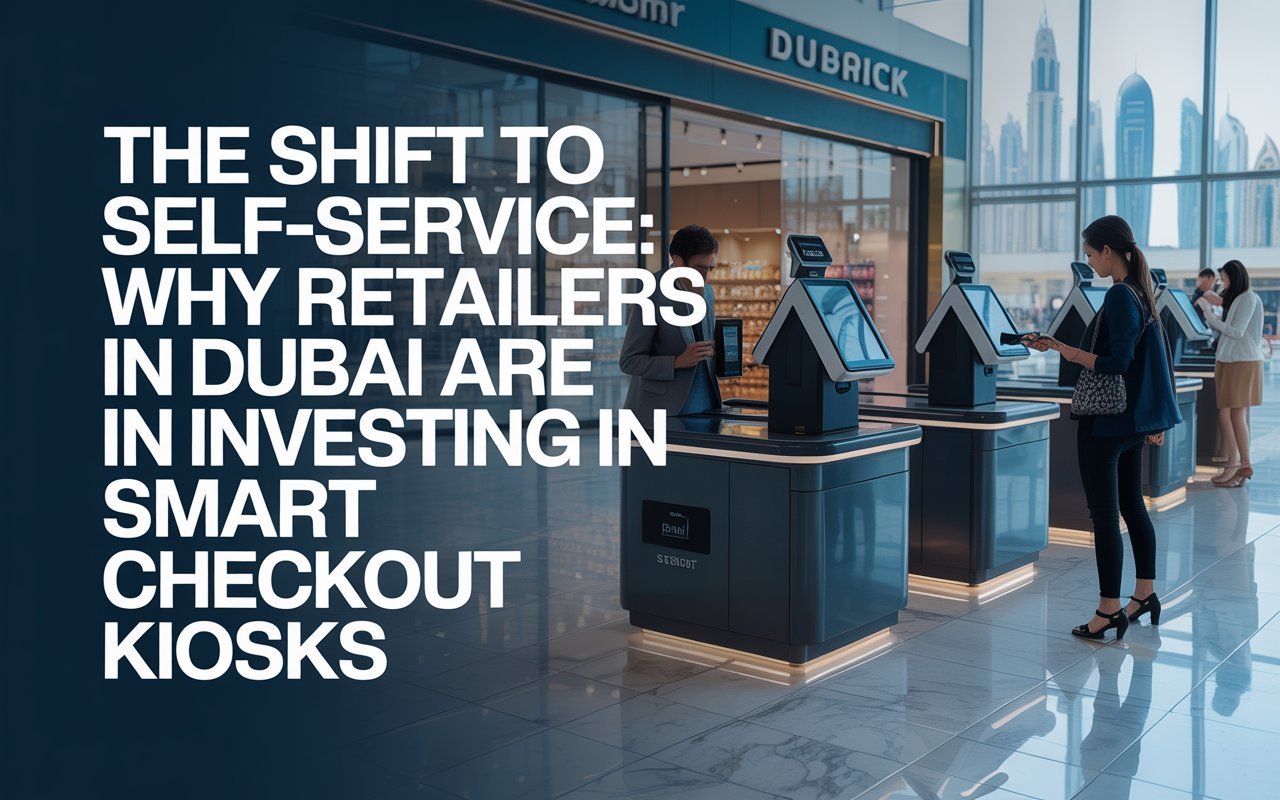
The Shift to Self-Service: Why Retailers in Dubai are Investing in Smart Checkout Kiosks
Introduction: Dubai Retail Is at a Crossroads
Walk into any major mall in Dubai today — Mall of the Emirates, Dubai Mall, or Ibn Battuta — and something has quietly changed. The long queues at staffed checkout counters are shrinking. In their place, sleek, touch-enabled kiosks are handling transactions faster, more accurately, and without a single word spoken between customer and cashier.
This is not a temporary experiment. It is a structural shift.
Dubai’s retail sector processed over AED 76 billion in consumer spending in 2023, and the pressure on retailers to reduce operational costs while improving customer experience has never been more intense. Staff shortages, rising wage expectations, peak-hour congestion, and customers who increasingly expect Amazon-speed convenience have created a perfect storm.
Smart checkout kiosks are the answer many retailers are now deploying — not as a novelty, but as a core operational investment.
This article explores what smart checkout kiosks actually are, why Dubai’s retail landscape is uniquely suited for them, what the technology looks like in practice, and what any retailer — from a hypermarket to a boutique fashion store — should know before making the investment.
What Is a Smart Checkout Kiosk?
A smart checkout kiosk is a self-contained, automated point-of-sale (POS) terminal that allows customers to scan, bag, and pay for their items without cashier assistance. Unlike traditional self-checkout machines, which are often clunky and error-prone, modern smart kiosks integrate artificial intelligence, computer vision, biometric authentication, and cloud-based inventory systems into a unified experience.
The key distinction is intelligence. A conventional self-checkout machine reads barcodes. A smart checkout kiosk can recognize items by shape and weight, detect scanning errors in real time, accept payments via NFC, QR code, or facial recognition, and flag anomalies that indicate potential theft — all simultaneously.
In Dubai’s context, these kiosks are also increasingly multilingual, with Arabic, English, Hindi, and other language options built in to serve the emirate’s diverse population.
The Dubai Retail Context: Why Now?
Several converging forces explain why Dubai’s retailers are accelerating adoption specifically in this period.
Labor market dynamics. The UAE’s retail sector employs a significant proportion of expatriate workers, and post-pandemic recruitment has become increasingly competitive and costly. Automating checkout reduces dependency on large front-end staffing pools without necessarily reducing headcount — it reallocates staff to higher-value roles like customer service and shelf management.
Customer expectations shaped by global travel. Dubai residents and visitors are globally mobile. They have used self-checkout systems in London, Tokyo, and New York. They arrive expecting similar or better experiences. Retailers who cannot match that expectation lose ground to those who can.
Government alignment with Vision 2031. The UAE’s broader digital economy strategy actively encourages technology adoption across sectors. Smart kiosk deployment aligns with Dubai’s smart city initiatives, making it a commercially and reputationally sound decision for retailers operating in the emirate.
Space optimization pressures. Retail real estate in Dubai is premium-priced. A bank of six smart kiosks typically occupies the same floor area as two traditional staffed checkout counters — while handling the same or greater transaction volume.
Core Features and Attributes of Modern Smart Checkout Kiosks
Understanding what separates a basic self-checkout machine from a genuine smart kiosk matters for retailers evaluating their options.
1. AI-Powered Item Recognition
Advanced kiosks no longer rely solely on barcode scans. They use overhead cameras combined with machine learning models to identify items by visual appearance — useful for fresh produce, bakery items, and non-barcoded goods that cause friction in traditional systems.
2. Weight-Verified Bagging Stations
The bagging area is equipped with precision scales that verify item weight against product database records in real time. This dramatically reduces both accidental scanning errors and intentional theft — a persistent concern in high-volume retail.
3. Multi-Modal Payment Acceptance
Modern kiosks accept cash, credit and debit cards, Apple Pay, Google Pay, Samsung Pay, QR-code payments, and increasingly, UAE PASS digital identity authentication. In Dubai’s cashless-leaning consumer environment, flexible payment architecture is non-negotiable.
4. Age Verification and Restricted Item Handling
For items requiring age verification — tobacco, energy drinks — smart kiosks can trigger automated ID scanning or alert a nearby staff member via mobile notification rather than halting the entire checkout process.
5. Real-Time Analytics Dashboard
Every transaction, abandoned scan, payment failure, and queue time is captured and transmitted to a cloud-based management dashboard. Retailers gain granular visibility into peak hours, product scanning failure rates, and customer flow patterns — data that previously required dedicated mystery shoppers or manual observation.
6. Remote Monitoring and Maintenance
Smart kiosks communicate system health status continuously. A low receipt paper alert, a stuck bill in the cash dispenser, or a camera calibration issue triggers an automatic notification before it becomes a customer-facing problem.
7. Accessibility Features
Adjustable screen heights, audio-guided checkout options, tactile buttons, and multilingual interfaces ensure compliance with UAE accessibility standards while serving Dubai’s genuinely diverse customer population.
Dubai Retail Segments Leading Adoption
Smart checkout kiosks are not a one-size-fits-all technology. Different retail segments are adopting them at different rates and for different strategic reasons.
Hypermarkets and Grocery Chains
Carrefour UAE, Lulu Hypermarket, and Spinneys have all piloted or expanded self-checkout zones in their Dubai locations. For grocery retail, the primary driver is queue management at peak times — Friday evenings, weekends, and holiday periods when staffed lanes become bottlenecks.
Grocery kiosks must handle high SKU diversity, loose produce, and multi-item transactions efficiently. The AI item-recognition capability is particularly valuable here, as a significant share of grocery items — especially in UAE supermarkets with large fresh food sections — either lack barcodes or have damaged labels.
Fashion and Apparel Retail
Fashion retailers in Dubai Mall and City Walk are exploring RFID-enabled smart checkout, where RFID tags embedded in clothing allow customers to place an entire basket of items on the kiosk surface and have all items detected simultaneously — no individual scanning required.
Brands including Zara, H&M, and regional fashion labels have tested this technology in GCC locations. Checkout time drops from an average of four minutes per customer to under sixty seconds.
Quick-Service Restaurants and Food Courts
Technically adjacent to retail, QSR brands in Dubai’s food courts — McDonald’s, Shake Shack, and local fast casual chains — have adopted ordering kiosks that function on the same underlying smart terminal architecture. These deployments demonstrate customer comfort with self-service transactions across categories, which accelerates acceptance in adjacent retail environments.
Convenience and Petrol Station Retail
ENOC, ADNOC Distribution, and similar operators run high-footfall convenience stores attached to fuel stations. Checkout speed is everything in this environment. A single smart kiosk handling ten customers per hour during a peak shift represents meaningful revenue-per-labor-hour improvement.
Airport and Travel Retail
Dubai International Airport is one of the world’s busiest, with retail dwell time representing significant revenue opportunity. Duty-free retailers and news agents within the terminal are deploying smart kiosks to serve time-pressured travelers who want frictionless, fast transactions.
How Smart Checkout Kiosks Compare to Traditional Alternatives
A clear-eyed comparison helps retailers understand exactly what they are buying and what they are giving up.
| Feature | Traditional Staffed Checkout | Basic Self-Checkout | Smart Checkout Kiosk |
| Transaction Speed | 3–5 min average | 2–4 min average | 45–90 seconds average |
| Staffing Requirement | 1 per lane | 1 per 4–6 lanes | 1 per 8–12 kiosks |
| Item Recognition | Manual scan | Barcode only | Barcode + AI vision |
| Payment Options | Most methods | Card/cash basic | Full omni-payment |
| Theft Detection | Human judgment | Weight check only | AI + weight + camera |
| Analytics Capability | None | Basic transaction log | Real-time cloud dashboard |
| Customer Language Support | Staff-dependent | Limited | Multi-language built-in |
| Accessibility | Staff-assisted | Limited | Full compliance-ready |
| Initial Investment | Low | Moderate | Higher upfront |
| 3-Year TCO | High (labor) | Moderate | Low (operational savings) |
The total cost of ownership argument is where smart kiosks make the strongest case. The upfront hardware and software investment — typically AED 35,000 to AED 85,000 per unit depending on specification — is offset within 18 to 30 months in most Dubai deployment scenarios when labor cost savings and throughput improvements are factored in.
Retail Adoption Rate: Dubai vs. Global Benchmarks
Dubai sits meaningfully below leading markets — which is precisely why the growth trajectory here is so steep. Retailers entering the market now are early enough to build competitive advantage, but late enough to deploy proven, de-risked technology.
Industry projections suggest the UAE self-checkout market will grow at a compound annual rate of approximately 14.2% through 2028, driven predominantly by Dubai and Abu Dhabi deployments.
Implementation Overview: What the Deployment Process Looks Like
For retailers considering investment, the implementation journey typically follows a structured sequence.
Phase 1 — Needs Assessment and Site Survey (Weeks 1–3)
A technology partner conducts footfall analysis, peak transaction mapping, and physical space assessment. This determines the optimal number of kiosks, their placement, and the specific feature set required. A grocery hypermarket has very different requirements from a fashion boutique.
Phase 2 — POS Integration and Software Configuration (Weeks 3–8)
Smart kiosks must integrate with the retailer’s existing inventory management system, loyalty program, and ERP platform. In Dubai, common retail platforms include Oracle Retail, SAP S/4HANA, and Lightspeed. Integration complexity is the most variable factor in deployment timelines.
Phase 3 — Staff Training and Change Management (Weeks 6–10)
Counterintuitively, staff play a critical role in smart kiosk success. Floor attendants must be trained to assist customers who encounter difficulty, manage escalation workflows for age-restricted items, and monitor the analytics dashboard. Retailers who invest in this phase see significantly better customer satisfaction scores.
Phase 4 — Soft Launch and Calibration (Weeks 8–12)
A soft launch period — typically two to four weeks — allows the AI item recognition system to learn the specific product catalog, and allows staff to identify friction points before full deployment.
Phase 5 — Full Deployment and Optimization (Ongoing)
Post-launch, the analytics dashboard drives continuous improvement. Transaction failure rates, average checkout times, and customer satisfaction metrics guide configuration updates and process refinements.
Key Vendors Operating in the UAE Market
Several hardware and software vendors are active in the Dubai smart kiosk space. Retailers evaluating options should consider both global providers and regional specialists.
NCR Atleos — One of the world’s largest self-checkout hardware providers, with GCC distribution partnerships and proven integration capability with major UAE retail POS systems.
Toshiba Global Commerce Solutions — Strong presence in grocery and hypermarket segments; their TCx Sky software platform powers several GCC deployments.
Diebold Nixdorf — Known for robust hardware reliability and strong cash-handling capabilities — relevant in Dubai given continued cash usage among certain customer segments.
Pyramid Computer (Kiosk Division) — European manufacturer with growing Middle East presence; attractive for retailers seeking customized form factors for premium or fashion environments.
Local System Integrators — Companies such as Redington Gulf, Mindware, and Al Fara’a Group provide regional implementation, maintenance, and support services that global vendors depend on for last-mile execution in the UAE.
Challenges Retailers Must Navigate
A candid article must also address the friction points.
Customer Resistance Among Certain Demographics. Older customers and those less comfortable with technology may resist or struggle with self-checkout. Dubai’s retail environment serves an exceptionally diverse demographic — from tech-forward young professionals to older visiting family members unfamiliar with touchscreen transactions. Designing for this breadth requires thoughtful UX and readily available staff assistance.
Shrinkage Concerns. Early generation self-checkout systems had measurable shrinkage (theft) problems. Modern smart kiosks have largely addressed this through AI-monitored bagging stations and camera systems, but retailers must still implement appropriate loss prevention protocols rather than assuming technology alone eliminates the problem.
Connectivity Dependencies. Cloud-connected kiosks require reliable internet infrastructure. Most Dubai retail environments have robust connectivity, but edge cases — a mall with network congestion during a peak event, for example — require offline transaction capability as a failsafe.
Integration Complexity with Legacy Systems. Retailers running older POS infrastructure may face significant integration costs and timelines. The kiosk itself is rarely the expensive part; connecting it to existing systems often is.
Maintenance Commitment. Smart kiosks require proactive maintenance. A failed kiosk during a Friday evening peak is a meaningful customer experience problem. Retailers without an internal maintenance capability need clear SLA commitments from their vendor or integrator.
FAQ: Smart Checkout Kiosks in Dubai Retail
Q1: What is the average return on investment timeline for smart checkout kiosks in Dubai?
Most Dubai retailers see full return on investment within 18 to 30 months, depending on deployment scale, transaction volume, and labor cost baseline. High-footfall locations — grocery stores, hypermarkets, airport retail — tend to achieve payback faster because the throughput improvement compounds across a higher transaction count. Retailers should model ROI based on their specific average transactions per hour, staffing costs, and lease costs per square meter, as these variables significantly influence the outcome.
Q2: Can smart checkout kiosks handle Arabic-language transactions and local payment methods?
Yes. Leading kiosk systems deployed in the UAE are configured for full Arabic language support, including right-to-left interface orientation. Payment integration covers UAE-specific methods including Etisalat Wallet, du Pay, and UAE PASS digital identity. Local vendors and system integrators typically handle this localization as part of the deployment package.
Q3: How do smart kiosks address the risk of shoplifting or scanning errors?
Modern systems use a combination of computer vision cameras, precision weight sensors in the bagging area, and AI anomaly detection to flag discrepancies between scanned items and bagged items. When a discrepancy is detected, the system pauses the transaction and notifies a floor attendant via mobile alert rather than locking the machine entirely — preserving customer flow while maintaining loss prevention discipline.
Q4: What happens if a customer needs help or encounters a problem at a kiosk?
Well-implemented kiosk deployments always include a staffed oversight role. A single floor attendant can monitor eight to twelve kiosks simultaneously using a tablet-based dashboard that surfaces alerts in real time. Most issues — unexpected items, payment failures, receipt questions — are resolved in under sixty seconds with staff intervention. The customer experience is typically faster than waiting in a traditional queue even when an intervention is needed.
Q5: Do smart kiosks work with loyalty programs and promotional pricing?
Yes, provided the kiosk software is properly integrated with the retailer’s loyalty platform. Customers can scan loyalty cards, enter phone numbers, or use app-based QR codes at the kiosk to apply points and discounts. Promotional pricing — including time-limited offers, buy-one-get-one mechanics, and basket-level discount thresholds — is handled through the same POS integration that governs staffed checkouts. Any pricing that works at a staffed terminal can be replicated at the kiosk.
Q6: Are smart checkout kiosks suitable for small or boutique retailers in Dubai, or only large chains?
The technology has historically been most cost-effective for high-volume retailers, but the unit economics have shifted. Compact kiosk units now exist at lower price points — AED 20,000 to AED 35,000 — that are viable for medium-footfall boutiques, specialty food stores, and pharmacy chains. For genuinely small businesses with fewer than 100 daily transactions, the ROI case is harder to make, but retailers should evaluate total operational context rather than transaction count alone.
Q7: How does the UAE’s multilingual, multicultural customer base affect kiosk design decisions?
This is one of the most nuanced considerations in the Dubai context. The emirate’s retail customer base includes Arabic speakers, English speakers, South Asian communities, East Asian tourists, and many others. Leading kiosks support four to eight language options accessible from the startup screen. Icon-forward UX design — where visual communication reduces language dependency — is also a valuable design principle for this environment. Retailers should explicitly request multilingual interface capability and test it in their specific demographic context during the pilot phase.
The Bigger Picture: Self-Service as a Retail Strategy, Not Just a Technology
It would be a mistake to frame smart checkout kiosks purely as a cost-cutting tool. The retailers in Dubai succeeding with this technology understand something more nuanced.
Self-service done well is a customer experience investment. It gives customers control — the ability to move at their own pace, review their basket, check prices, and complete transactions without social pressure or time constraints. That experience builds loyalty in a market where switching costs between competing retailers are low.
It also frees staff to do what technology genuinely cannot: create human connections, offer product knowledge, handle complex customer needs, and build the brand relationships that drive repeat visits.
The smartest retail operators in Dubai are not deploying kiosks to replace staff. They are redeploying staff. The checkout counter was never the highest-value place for a trained retail employee to spend their time. Smart kiosks free that time for floor engagement, personal styling consultation, product education, and complaint resolution — activities that genuinely differentiate one retailer from another.
This framing also addresses the workforce concern that follows every conversation about automation. Retail employment in Dubai is not disappearing because of kiosks. It is evolving. The skills required are changing — and retailers who invest in both the technology and the training are the ones building genuinely durable competitive positions.
Conclusion: The Window for Competitive Advantage Is Open — But Not Forever
Dubai’s retail sector is at an inflection point. Smart checkout kiosks have moved past the experimental phase. The technology is proven, the vendor ecosystem in the UAE is mature, and consumer comfort with self-service transactions is at an all-time high.
Retailers who invest now — thoughtfully, with proper integration and staff alignment — will capture meaningful advantages: lower operational costs, higher throughput, richer analytics, and customer experiences that match the expectations of a globally sophisticated consumer base.
Retailers who wait will eventually be forced to adopt, but without the brand perception benefit of being ahead of the curve, and likely at higher unit costs as the technology matures into a market standard.
The question is not whether smart checkout kiosks belong in Dubai retail. They already do. The question is which retailers will lead the transformation — and which will follow.