

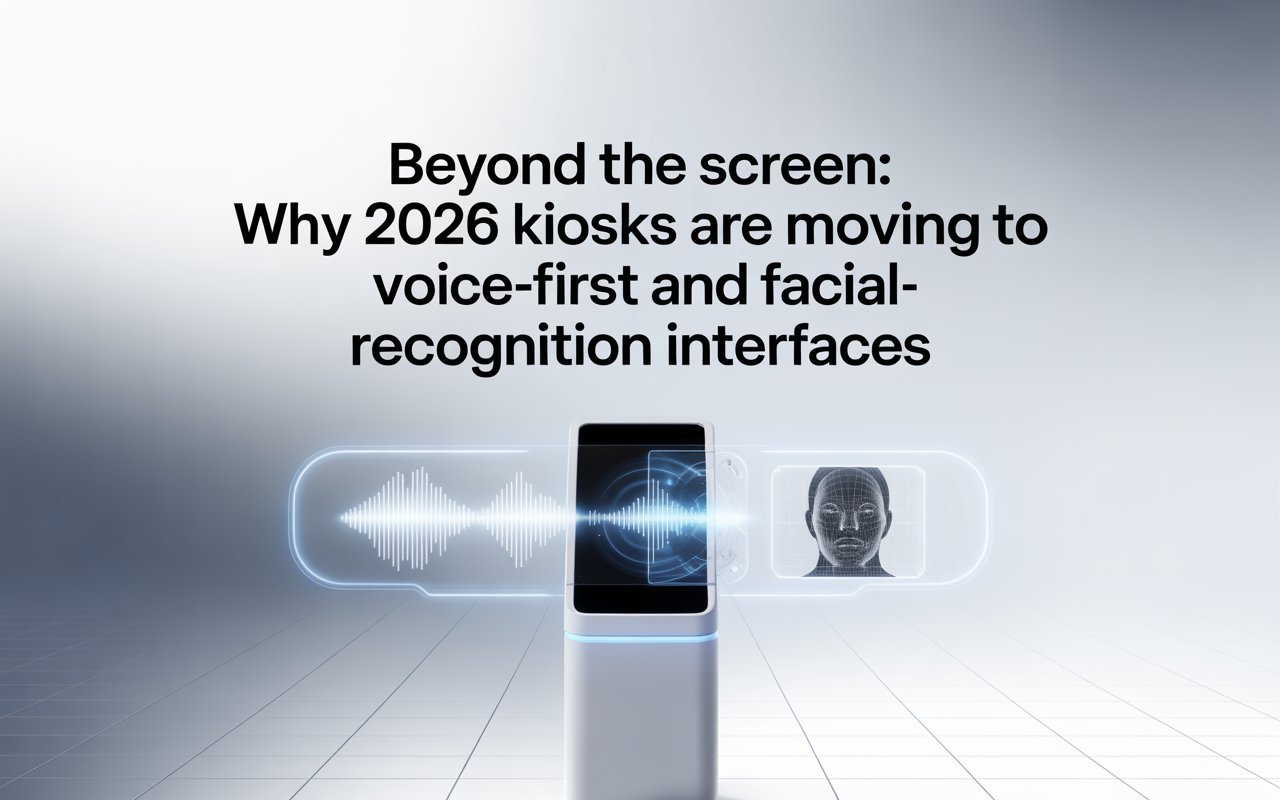
Beyond the Screen: Why 2026 Kiosks are Moving to Voice-First and Facial-Recognition Interfaces.
A modern biometric kiosk platform represents a critical shift in self-service technology as touchscreens fail to meet evolving customer expectations. Walk into any major bank branch or flagship retail store today and you will still find a traditional touchscreen kiosk—a flat, glass panel waiting for a finger that may never come. The technology works, but it is rapidly becoming the wrong answer to a question customers stopped asking.
The global self-service kiosk market, valued at over $32 billion in 2024, built its entire architecture around one assumption: that a person’s primary method of interacting with a machine is physical touch. That assumption served the industry well through the 2010s, but it no longer does in 2026.
Consider what has shifted. Customers today routinely speak commands to AI assistants, unlock devices with their faces, and expect software to know their preferences before they articulate them. When they arrive at a terminal that demands they navigate a five-layer menu with their index finger, the experience feels slow, impersonal, and outdated. Touchscreen interfaces generate three structural friction points that cost businesses measurable revenue: high surface-hygiene abandonment, slow transaction speed ceilings averaging 47 seconds, and zero personalization at scale.
The answer the market has been building toward is a fundamentally different interaction paradigm: a voice-first, biometrically authenticated, AI-personalized system that recognizes who you are, understands what you want, and completes transactions in seconds rather than minutes.
What Exactly Is a Voice-First Biometric Kiosk?
A voice-first biometric kiosk is a self-service terminal whose primary interaction modality is spoken language and whose authentication layer relies on physiological identifiers—facial geometry, voice print, or both—rather than PINs, cards, or passwords.
The distinction matters because it describes a full architectural inversion. Traditional systems are display-driven: the machine shows options and waits for physical input. In contrast, an advanced biometric kiosk platform is intent-driven: the machine listens, identifies, anticipates, and responds. To better understand how these physical attributes are mathematically categorized, you can review the technical guidelines on Biometrics on Wikipedia.
AEC-INT’s 2026 hardware units exemplify this shift by housing a highly integrated software stack:
- Passive Facial Recognition Engine: A near-infrared camera array running a liveness-detection neural network that identifies users within 1.2 seconds of approach.
- Natural Language Processing: An on-device large language model handling spoken requests locally in over 40 languages with sub-200ms latency.
- Adaptive Personalization Layer: A behavioral model that pre-populates account summaries and suggests frequent transaction types based on historical interactions.
- Multi-Factor Biometric Authentication: Combining facial geometry with voice-print verification to meet or exceed strict PSD2, FIDO2, and ISO/IEC 30107 standards.
- Privacy-By-Design Architecture: Storing templates as one-way mathematical transformations to strictly satisfy GDPR, CCPA, and BIPA requirements.
Core Attributes and Features of the AEC-INT Platform
Understanding a technology’s commercial value requires moving past specification sheets and into the attributes that determine real-world performance. The AEC-INT biometric kiosk platform sits in five core capability clusters:
1. Edge-Native AI Processing
The most consequential architectural decision was to process all biometric matching and NLP inference on-device. The hardware includes a dedicated neural processing unit (NPU) capable of 38 TOPS (tera-operations per second). The practical impact: the kiosk functions identically with or without internet connectivity, is immune to cloud latency spikes, and keeps data physically within the premises.
2. Sub-Second Recognition and Predictive UI
The platform’s facial recognition model achieves a 99.4% true positive rate at a 1-in-1,000,000 false acceptance rate. Simultaneously, the biometric kiosk platform runs a continuous inference loop that predicts user intent before the interaction formally begins. In retail environments, returning customers instantly see a personalized welcome screen with their frequent categories pre-loaded, driving transaction speeds under 8 seconds.
How AEC-INT Compares to Legacy Platforms
A clear-eyed industry comparison highlights exactly why standardizing on an intelligent biometric kiosk platform yields superior operational performance over cloud-dependent or tablet alternatives:
| Capability | AEC-INT Biometric Platform | Legacy Touchscreen OEM | Cloud-Dependent AI Kiosk |
|---|---|---|---|
| Facial Recognition | On-device, <1.2s | Not available | Cloud-dependent |
| Voice Interface | 40+ languages, on-device NLP | Touch-only | Limited languages |
| Offline Operation | Full functionality | Basic only | Requires connectivity |
| Compliance (GDPR/BIPA) | Built-in, user-managed | N/A | Vendor-dependent |
| Average Transaction Time | 7–13 seconds | 42–74 seconds | 18–35 seconds |
| Hardware Lifespan | 8–10 years (modular) | 5–7 years | 3–5 years |
Use Cases, Industries Served, and Applications
An enterprise-grade biometric kiosk platform translates across any environment where high-volume human-machine transactions occur:
- Retail: Personalized loyalty point redemption without apps or cards, age verification for restricted purchases, and voice-navigated product searches.
- Banking & Financial Services: Cardless cash withdrawals via face and voice verification, zero-keystroke account balance retrieval, and instant customer onboarding with live biometric ID verification.
- Hospitality & Travel: Hotel check-in and room key issuance completed in under 10 seconds, paired with multi-language concierge queries via localized NLP.
- Healthcare: Patient check-in with live insurance verification, HIPAA-compliant medical record retrieval, and touchless prescription pickups.
Implementation Overview: From Procurement to Go-Live
Deploying a modern biometric kiosk platform network follows a structured path over an 8-to-18-week horizon. Phase one focuses on site surveys and ambient lighting analysis to establish optimal camera angles. Phase two outlines the biometric enrollment strategy, allowing users to enroll via kiosk self-service, mobile app pre-enrollment, or staff-assisted channels. System integration follows via pre-built core banking and retail ERP APIs, leading into staff change management and post-launch federated learning model optimization.
Frequently Asked Questions
Is utilizing a biometric kiosk platform legal under global data regulations?
Yes. Biometric deployments are fully compliant with GDPR, CCPA, and BIPA by design, provided consent is captured interactively at enrollment and templates are stored strictly as one-way mathematical transformations that can be deleted by the user at any time.
How does this system handle users who do not want to use biometrics?
Biometric enrollment is completely voluntary. An enterprise-grade biometric kiosk platform maintains a full parallel path for standard card swipes, PIN entries, or manual ID inputs so that no user is ever locked out of service.
What prevents presentation or spoofing attacks like photos and videos?
The system employs advanced presentation attack detection (PAD) certified to ISO/IEC 30107-3 Level 2. It analyzes passive depth and micro-textures to instantly distinguish live faces from prints or screen replays, securing high-risk transactions.
Conclusion: Leading the Self-Service Transformation
The heuristic of product design is simple: the best technology is the technology that gets out of the way. Voice-first, biometrically authenticated systems invert old self-service models entirely, ensuring the machine arrives at the interaction already knowing who it is speaking to and anticipating what they need.
Incorporating the top biometric kiosk platform options ensures your corporate infrastructure is completely optimized for long-term operational efficiency, shorter queue lengths, and lower overall total cost of ownership. To discover premium, edge-native terminal configurations for your enterprise, review the customized hardware architectures available at AEC International today.