

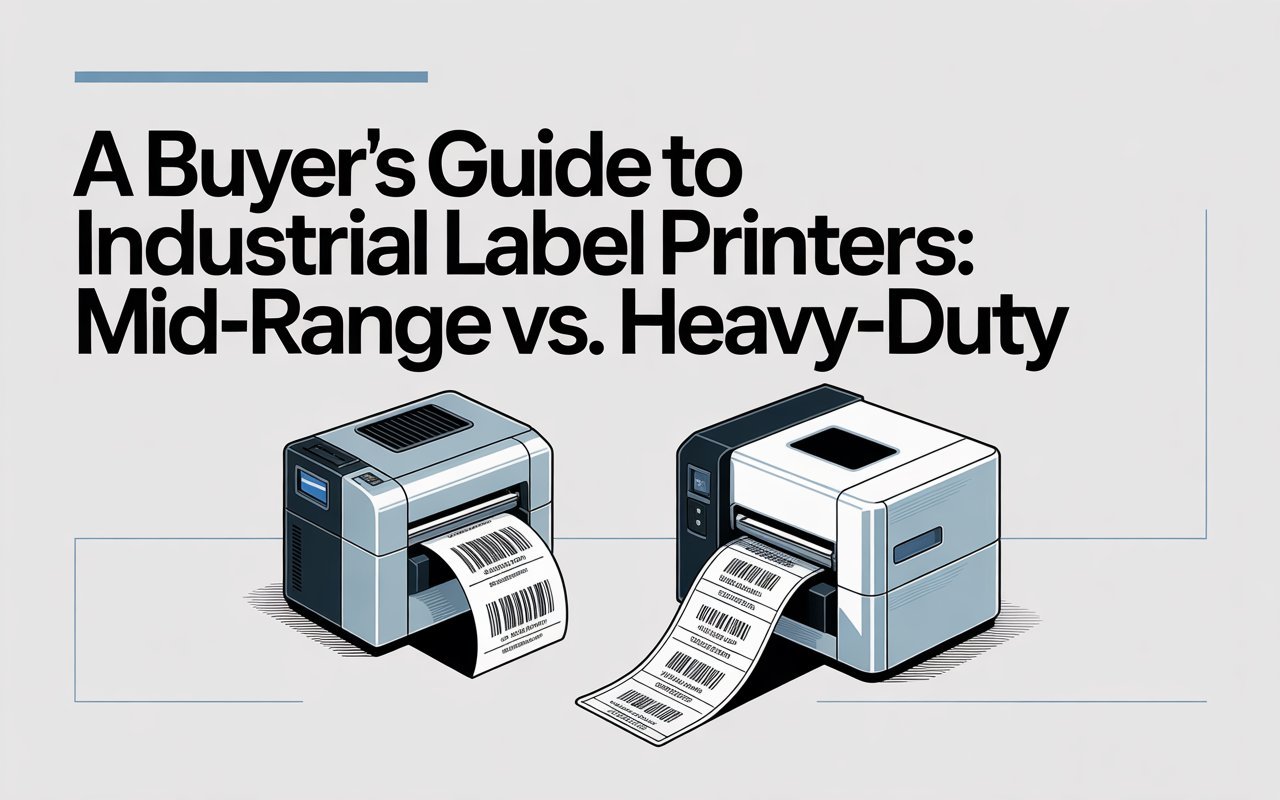
A Buyer’s Guide to Industrial Label Printers: Mid-Range vs. Heavy-Duty
Industrial label printers represent a critical investment that most plant managers don’t fully appreciate until something breaks. You approved the purchase. The label printer arrived. Six months later, the print head burned out, labels are peeling off pallets in the cold-storage warehouse, and your line supervisor is hand-writing barcodes at 2 a.m. before a shipment deadline.
This is not a hypothetical. It happens in food processing facilities, automotive parts warehouses, chemical distribution centers, and electronics assembly plants every single year. And almost every time, the root cause is the same: the buyer chose a printer based on price bracket rather than operational fit.
Sourcing industrial label printers sounds straightforward until it isn’t. The moment you factor in daily print volume, substrate type, ambient temperature, chemical exposure, and compliance requirements, the decision tree becomes genuinely complex. A printer that performs beautifully in a climate-controlled office fulfillment room can fail within weeks when placed on a concrete floor next to a forklift lane operating at 35°F.
This guide exists to eliminate that gap. Whether you are sourcing thermal industrial label printers for the first time or replacing aging hardware across multiple production lines, the frameworks and comparisons here will help you match the right machine to your real-world operating environment, not just your purchase order budget.
What Are Industrial Label Printers?
Industrial label printers are purpose-built devices designed to produce adhesive labels at high volumes, under demanding environmental conditions, with consistent output quality across long duty cycles. Unlike desktop or commercial-grade models used in office or light retail environments, heavy-duty industrial label printers are engineered for continuous operation, rugged physical handling, and integration into larger manufacturing or logistics workflows.
The dominant technology in this category is thermal printing, which subdivides into two methods:
- Direct thermal printing applies heat directly to chemically treated label stock, producing an image without ink or ribbon. It works well for short-term labels like shipping labels, receipts, and temporary asset tags, but the labels fade when exposed to prolonged heat, UV light, or abrasion.
- Thermal transfer printing uses a heated print head to melt ink from a ribbon onto the label substrate. The result is a durable, long-lasting print that resists heat, chemicals, moisture, and UV exposure. You can read more about the technical specifications of this process via Thermal Transfer Printing on Wikipedia.
Why Shipping Logistics Rely on Industrial Label Printers
Before comparing mid-range and heavy-duty models, it helps to understand why the entire industrial world converged on thermal printing. Why shipping facilities use thermal industrial label printers comes down to five structural advantages over inkjet or laser alternatives:
1. No Consumable Ink Costs
Direct thermal printers eliminate ink cartridges entirely. For high-volume shipping operations printing thousands of labels per day, the cost reduction is significant. There are no cartridges to run dry mid-shift, no color management issues, and no downtime for ink replacement.
2. Print Speed That Matches Production Line Rates
Thermal print heads activate almost instantaneously. Modern thermal industrial label printers routinely achieve speeds of 6 to 14 inches per second, fast enough to keep pace with automated conveyor systems without creating a bottleneck.
3. High-Contrast Output for Barcode Accuracy
The binary nature of thermal printing produces sharp, high-contrast edges on barcodes and QR codes. This is critical for scan accuracy in automated warehouse and logistics environments where misreads cause downstream errors.
4. Resistance to Environmental Variables
Thermal transfer labels printed on the right substrate can withstand freezer temperatures, direct sunlight, chemical splashes, and abrasion. The environmental resilience of industrial label printers is precisely why inkjet prints fail by comparison.
5. Low Maintenance, High Reliability
Thermal systems have fewer moving parts than ink-based alternatives. No ink delivery system means fewer failure points. In 24/7 manufacturing environments, mean time between failures matters as much as unit cost.
Mid-Range vs. Heavy-Duty Industrial Label Printers
The market for industrial label printers broadly separates into two tiers for manufacturing environments: mid-range (commercial-industrial) and heavy-duty (true industrial-grade). Here is how they differ across the attributes that matter most.
Print Volume Capacity
This is the single most important specification. Mid-range industrial label printers are designed for moderate, predictable workloads, supporting 1,000 to 5,000 labels per day. They are appropriate for single-shift operations.
Heavy-duty industrial label printers are built for sustained, high-volume output. These machines handle 10,000 to 20,000+ labels per day without degrading print quality. They are equipped with larger media rolls, reinforced print heads, and cooling systems that prevent heat buildup. The critical mistake buyers make is sizing their hardware for average volume rather than peak season volume.
Print Resolution: DPI and Practical Application
Resolution in industrial label printers is measured in dots per inch (DPI). 203 DPI is the baseline for most standard shipping barcodes. 300 DPI is the workhorse resolution for manufacturing compliance labels and 2D matrix codes. 600 DPI is the precision tier, necessary for tiny components, GS1 DataBar codes, and medical device manufacturing.
Environmental Durability
Introducing a printer to a manufacturing floor without evaluating environmental conditions guarantees failure. Here are the factors that separate the tiers:
- Operating Temperature: Mid-range models operate reliably between 41°F and 104°F. Heavy-duty models extend this range down to 32°F (0°C) for refrigerated lines.
- Ingress Protection: Heavy-duty industrial label printers frequently achieve IP54 (dust and splash-proof), making them suitable for food processing facilities.
- Shock and Vibration: On production floors, premium industrial label printers are constructed with metal chassis and locking media holders to maintain calibration around heavy machinery.
- Chemical Exposure: In automotive environments, top-tier industrial label printers feature housing materials resistant to aerosols and cleaning agents, whereas standard ABS plastic degrades.
Industry Applications for Industrial Label Printers
Food and Beverage Manufacturing
Food processing facilities operate under rigorous hygiene standards. Heavy-duty industrial label printers with IP54 ratings and sealed housings are the only appropriate choice to combat moisture exposure and temperature variations.
Automotive Parts Manufacturing
VIN labels and part identification codes need to survive paint shop heat and lubricant exposure. High-resolution heavy-duty industrial label printers are standard in this sector because 2D data matrix codes carry dense data in a small footprint.
Pharmaceutical and Medical Device Manufacturing
Serialization requirements mandate that every saleable unit carry unique traceability data. This sector drives massive demand for 600 DPI industrial label printers featuring environmental enclosures for cleanroom compatibility.
Electronics Assembly
Component labeling combines the challenges of tiny label formats, static-sensitive environments, and harsh cleaning solvents. Heavy-duty industrial label printers with fine-pitch print heads are critical tools for maintaining downstream scan rates.
Direct Comparison Table
| Specification | Mid-Range Industrial | Heavy-Duty Industrial |
|---|---|---|
| Daily print volume | 1,000 – 5,000 labels | 5,000 – 20,000+ labels |
| Print speed | 4 – 8 inches/second | 8 – 14 inches/second |
| Resolution options | 203 DPI, 300 DPI | 203, 300, 600 DPI |
| IP protection rating | IP41 or unrated | IP54 – IP65 |
| Chassis construction | ABS plastic, partial metal | Full metal, sealed |
Deploying Industrial Label Printers on the Plant Floor
Network Integration
Modern industrial label printers support Ethernet and Wi-Fi connectivity, enabling centralized print queue management. In large facilities, a print management platform allows administrators to push firmware updates and route jobs dynamically.
Ribbon and Media Selection
The thermal transfer ribbon must match the substrate. Wax ribbons work for paper, but full resin ribbons are required for synthetic substrates needing extreme temperature resistance. Mismatching ribbon and substrate is the most common cause of poor print quality.
Preventive Maintenance
Print head replacement is the primary recurring cost. Establishing a preventive maintenance schedule based on printed label counts rather than calendar time produces predictable replacement cycles. Cleaning the print head at each media change extends hardware life significantly.
Frequently Asked Questions
Why do shipping labels specifically use thermal printers instead of laser?
Thermal printing produces labels faster, more reliably, and at lower per-label costs. The absence of liquid ink eliminates smearing during handling, ensuring accurate sortation.
What volume distinguishes mid-range from heavy-duty industrial label printers?
The practical threshold is around 5,000 labels per day. Above that figure, heavy-duty construction is necessary to maintain consistent output quality and avoid accelerated print head wear.
Can mid-range industrial label printers be used in food processing?
Generally, no. Standard mid-range models lack the IP ratings required to withstand the moisture and washdown protocols common in food manufacturing.
What integration options should I look for connecting to an ERP?
Look for robust API availability, standard network connectivity, and command language support (ZPL/EPL). Heavy-duty printers typically offer more complete API documentation for automated GPIO triggering.
Conclusion: Choosing the Right Industrial Label Printers
The difference between mid-range and heavy-duty hardware is not about price; it is about operational fit. The decision framework is straightforward: What is your peak daily print volume? What are the environmental conditions? What resolution does your smallest barcode require?
If peak volume exceeds 5,000 labels, or the environment involves extreme temperature and moisture, the investment in heavy-duty industrial label printers pays for itself. To map out the perfect printing infrastructure for your production facility, explore the premium hardware options available at AEC International today.