

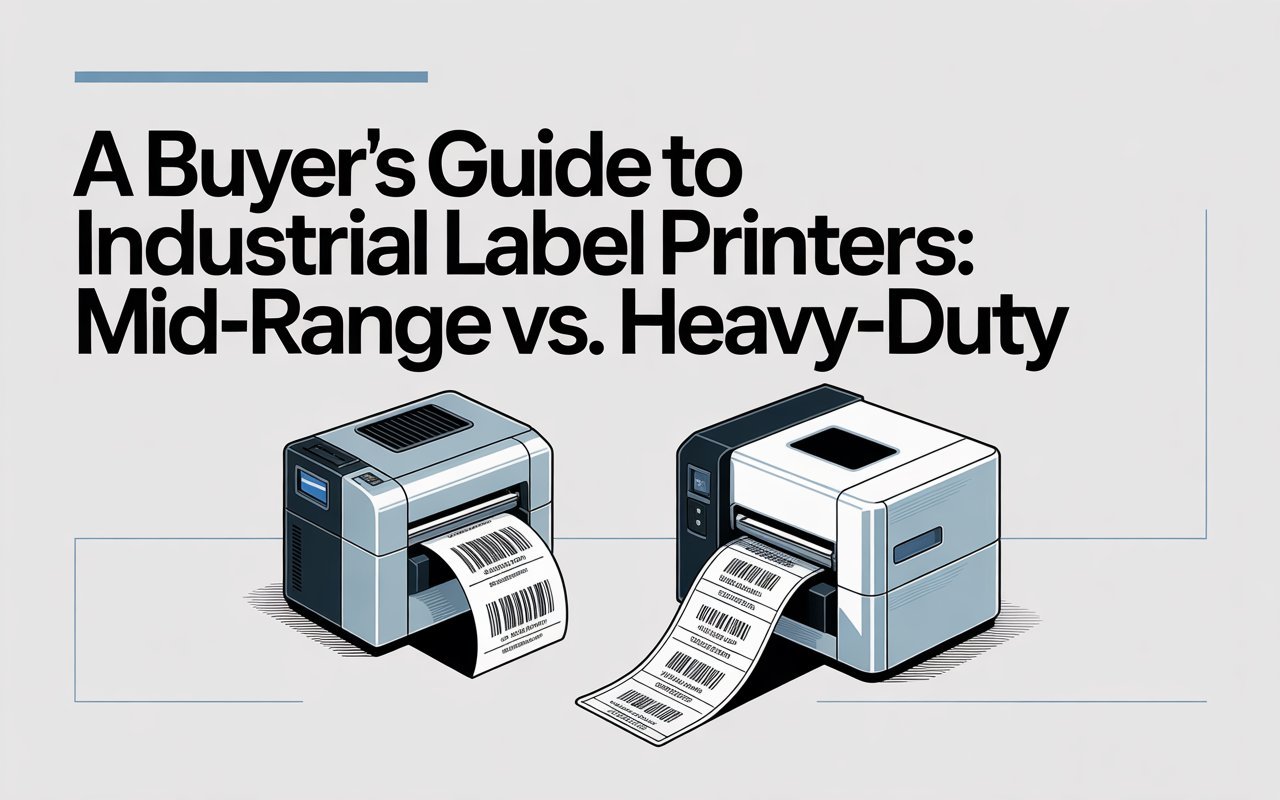
A Buyer’s Guide to Industrial Label Printers: Mid-Range vs. Heavy-Duty
The Problem Most Plant Managers Don’t See Coming
You approved the purchase. The label printer arrived. Six months later, the print head burned out, labels are peeling off pallets in the cold-storage warehouse, and your line supervisor is hand-writing barcodes at 2 a.m. before a shipment deadline.
This is not a hypothetical. It happens in food processing facilities, automotive parts warehouses, chemical distribution centers, and electronics assembly plants every single year. And almost every time, the root cause is the same: the buyer chose a printer based on price bracket rather than operational fit.
Industrial label printing sounds straightforward until it isn’t. The moment you factor in daily print volume, substrate type, ambient temperature, chemical exposure, and compliance requirements, the decision tree becomes genuinely complex. A printer that performs beautifully in a climate-controlled office fulfillment room can fail within weeks when placed on a concrete floor next to a forklift lane operating at 35°F.
This guide exists to eliminate that gap. Whether you are sourcing thermal label printers for the first time or replacing aging hardware across multiple production lines, the frameworks and comparisons here will help you match the right machine to your real-world operating environment, not just your purchase order budget.
What Is an Industrial Label Printer? (Defining the Entity)
An industrial label printer is a purpose-built device designed to produce adhesive labels at high volumes, under demanding environmental conditions, with consistent output quality across long duty cycles. Unlike desktop or commercial-grade label printers used in office or light retail environments, industrial models are engineered for continuous operation, rugged physical handling, and integration into larger manufacturing or logistics workflows.
The dominant technology in this category is thermal printing, which subdivides into two methods:
- Direct thermal printing applies heat directly to chemically treated label stock, producing an image without ink or ribbon. It works well for short-term labels like shipping labels, receipts, and temporary asset tags, but the labels fade when exposed to prolonged heat, UV light, or abrasion.
- Thermal transfer printing uses a heated print head to melt ink from a ribbon onto the label substrate. The result is a durable, long-lasting print that resists heat, chemicals, moisture, and UV exposure. This method is the standard for product identification labels, compliance labels, and anything expected to survive months or years in the field.
The term thermal label printers covers both methods, and understanding which one your application requires is the first real decision point in the buying process.
Why Shipping Labels Use Thermal Printers: The Core Advantage
Before comparing mid-range and heavy-duty models, it helps to understand why the entire industrial labeling world converged on thermal printing in the first place.
Why shipping labels use thermal printers comes down to five structural advantages over inkjet or laser alternatives:
1. No Consumable Ink Costs (Direct Thermal)
Direct thermal printers eliminate ink cartridges entirely. For high-volume shipping operations printing thousands of labels per day, the cost reduction is significant. There are no cartridges to run dry mid-shift, no color management issues, and no downtime for ink replacement.
2. Print Speed That Matches Production Line Rates
Thermal print heads activate almost instantaneously. Industrial thermal label printers routinely achieve speeds of 6 to 14 inches per second, fast enough to keep pace with automated conveyor systems without creating a bottleneck.
3. High-Contrast Output for Barcode Accuracy
The binary nature of thermal printing (heat-on or heat-off) produces sharp, high-contrast edges on barcodes and QR codes. This is critical for scan accuracy in automated warehouse and logistics environments where misreads cause downstream errors.
4. Resistance to Environmental Variables
Thermal transfer labels printed on the right substrate can withstand freezer temperatures, direct sunlight, chemical splashes, and abrasion, conditions that would cause inkjet prints to smear or laser prints to crack.
5. Low Maintenance, High Reliability
Thermal printers have fewer moving parts than ink-based alternatives. No ink delivery system means fewer failure points. In 24/7 manufacturing environments, mean time between failures matters as much as unit cost.
These advantages of thermal printers for shipping labels are precisely why the technology dominates logistics, manufacturing, healthcare, and retail distribution globally.
The Two Categories: Mid-Range vs. Heavy-Duty Industrial Label Printers
Now to the core comparison. The industrial label printer market broadly separates into two tiers for manufacturing environments: mid-range (sometimes called “commercial-industrial”) and heavy-duty (true industrial-grade). Here is how they differ across the attributes that matter most to plant operations.
Print Volume Capacity
This is the single most important specification, and the one most commonly underestimated at the point of purchase.
Mid-range industrial printers are designed for moderate, predictable workloads. Their duty cycles typically support somewhere between 1,000 and 5,000 labels per day. They are appropriate for single-shift operations, smaller assembly lines, or distribution centers with manageable daily order volumes.
Heavy-duty industrial printers are built for sustained, high-volume output. These machines can handle 10,000 to 20,000 or more labels per day without degrading print quality or triggering thermal overload shutdowns. They are equipped with larger media rolls, reinforced print heads rated for hundreds of millions of dot activations, and cooling systems that prevent heat buildup during extended runs.
The critical mistake buyers make is choosing based on average volume rather than peak volume. If your line runs 2,000 labels per day most of the time but spikes to 8,000 during peak season, a mid-range printer sized for the average will fail you precisely when reliability matters most.
Print Resolution: DPI and What It Actually Means in Practice
Resolution in thermal label printers is measured in dots per inch (DPI), and the right target depends entirely on what you are printing, not on a general preference for higher quality.
203 DPI is the baseline for most industrial thermal label printers. It is adequate for standard shipping barcodes, pallet labels, and basic product identification where label size is large enough to accommodate the code without compression errors.
300 DPI is the workhorse resolution for most manufacturing compliance labels. It delivers clean, scannable barcodes at smaller sizes, legible alphanumeric text in tight spaces, and reliable 2D matrix codes like Data Matrix and QR codes used in pharmaceutical and electronics traceability.
600 DPI is the precision tier. It is necessary for GS1 DataBar codes, small-format labels used in medical device manufacturing, serialization labels with embedded human-readable text alongside machine-readable codes, and any application where label real estate is minimal but information density is high.
Mid-range printers typically max out at 300 DPI. Heavy-duty models offer 300 or 600 DPI options, and some support print speed adjustments that trade velocity for precision, running at reduced speed to maximize dot placement accuracy.
Environmental Durability: The Attribute Buyers Underestimate Most
A thermal label printer is a precision instrument. Introducing it to a manufacturing environment without evaluating environmental conditions is the equivalent of placing office furniture in a machine shop and expecting it to hold up.
Here are the environmental factors that separate mid-range from heavy-duty:
Operating temperature range. Mid-range printers typically operate reliably between 41°F and 104°F (5°C to 40°C). Heavy-duty models extend this range significantly, with some rated for environments down to 32°F (0°C) or lower, covering refrigerated packaging lines and cold-chain logistics operations.
Ingress protection (IP rating). Mid-range printers often carry no formal IP rating or a low one (IP41, protecting against dripping water and objects over 1mm). Heavy-duty models frequently achieve IP54 (dust-partial protection, splash-proof from all directions) or higher, making them suitable for food processing facilities where water-spray cleandowns occur on a daily basis.
Shock and vibration resistance. On production floors with heavy machinery, forklifts, and conveyor systems, vibration is constant and physical impacts are periodic. Heavy-duty industrial label printers are constructed with metal chassis, reinforced media compartments, and locking media holders designed to maintain calibration under these conditions.
Chemical and solvent exposure. In automotive manufacturing, chemical processing, and cleaning product distribution, label printers may be exposed to aerosols, solvents, and cleaning agents. Housing materials on heavy-duty models are selected for resistance to these substances. Mid-range models with ABS plastic housings may degrade or discolor over time under similar exposure.
Industry Applications: Which Printer Serves Which Environment
Food and Beverage Manufacturing
Food processing facilities operate under rigorous hygiene standards, daily washdown protocols, and strict allergen and ingredient labeling requirements. The combination of moisture exposure, temperature variation between production and storage areas, and high label volumes makes this one of the most demanding environments for label printing.
Heavy-duty thermal transfer printers with IP54 or higher ratings and stainless steel or sealed housings are the appropriate choice. The label substrates used in this sector, polyester and polypropylene films with aggressive adhesives, require higher ribbon energy and consistent print head pressure to adhere correctly, characteristics that mid-range printers may struggle to maintain across long runs.
Automotive Parts Manufacturing
VIN labels, part identification codes, and assembly tracking labels in automotive environments need to survive paint shop heat, lubricant exposure, and decades of field service. Print resolution requirements are high because 2D data matrix codes used in automotive traceability carry dense data in a small footprint.
Heavy-duty printers with 300 or 600 DPI and thermal transfer capability are standard in this sector. The longevity of the printed label needs to match the service life of the part itself, making ribbon selection and substrate choice as important as printer specification.
Pharmaceutical and Medical Device Manufacturing
Serialization requirements under DSCSA and EU FMD regulations mandate that every saleable unit of prescription medication carry a unique serial number, product code, lot number, and expiration date in both human-readable and machine-readable formats. The label sizes involved are often extremely small, and the barcode standards require the highest scan accuracy rates achievable.
This sector drives demand for 600 DPI thermal transfer printers with validated print quality monitoring, environmental enclosures for cleanroom compatibility, and software integration with ERP and MES systems. Mid-range printers are generally not suited for primary packaging label printing in this environment.
Third-Party Logistics (3PL) and Distribution
Distribution centers occupy a middle zone. Some operations run high volumes across 24-hour shifts with multiple product lines; others handle moderate volumes for a focused product category. The environmental conditions are generally more controlled than manufacturing plants, but throughput expectations are high and downtime tolerance is low.
For large 3PL operations, heavy-duty printers are the reliable choice for primary shipping label lines. Mid-range printers may serve adequately at secondary packing stations, return processing areas, or receiving docks where volume is lower and conditions are more forgiving.
Electronics Assembly and PCB Manufacturing
Component labeling in electronics manufacturing combines the challenges of tiny label formats, static-sensitive environments, and the need for long-term label survival through wave soldering, cleaning solvents, and field use. Print head alignment and consistent media feed precision are critical.
Heavy-duty printers with fine-pitch print heads and optional static dissipation features are the appropriate tool. The investment in print quality here directly affects downstream scan rates in automated assembly and test equipment.
Mid-Range vs. Heavy-Duty: A Direct Comparison
| Specification | Mid-Range Industrial | Heavy-Duty Industrial |
| Daily print volume | 1,000 – 5,000 labels | 5,000 – 20,000+ labels |
| Print speed | 4 – 8 inches/second | 8 – 14 inches/second |
| Resolution options | 203 DPI, 300 DPI | 203, 300, 600 DPI |
| Duty cycle (print head) | 50–100M dot activations | 150–300M+ dot activations |
| Operating temp range | 41°F – 104°F | 32°F – 113°F (extended) |
| IP protection rating | IP41 or unrated | IP54 – IP65 |
| Chassis construction | ABS plastic, partial metal | Full metal, sealed |
| Media roll capacity | 5″ – 8″ outer diameter | 8″ – 10″ outer diameter |
| Connectivity | USB, Ethernet, Wi-Fi | USB, Ethernet, serial, GPIO |
| Integration depth | Basic driver-based | Full API and ZPL/EPL support |
| Typical unit cost | $400 – $1,200 | $1,200 – $4,500+ |
| Ideal environments | Light manufacturing, office | Plant floor, food, pharma |
Implementation Overview: Deploying Industrial Label Printers on the Plant Floor
Selecting the right printer is only the first step. Deployment decisions determine whether the hardware actually delivers its rated performance in your environment.
Network Integration and Print Management
Modern industrial thermal label printers support Ethernet and Wi-Fi connectivity, enabling centralized print queue management. In large facilities, a print management platform allows administrators to monitor printer status, push firmware updates, and route print jobs to specific units based on product line or station assignment. This eliminates the manual reprinting that results from job routing errors and enables real-time visibility into supply levels (ribbon, media, and label stock).
Label Design and Zonal Formatting
Thermal label printers respond to printer command languages, most commonly ZPL (Zebra Programming Language) and EPL, or proprietary equivalents from other manufacturers. Your label design software needs to produce output compatible with your printer’s command language. For operations running multiple printer brands, a middleware layer or a label design tool with universal output translation avoids fragmentation.
Ribbon and Media Selection
The thermal transfer ribbon composition must be matched to the label substrate. Wax ribbons are appropriate for paper labels in ambient conditions. Wax-resin ribbons offer improved scratch resistance for paper and some synthetic substrates. Full resin ribbons are required for synthetic substrates like polyester and polyimide, and for applications requiring chemical, UV, or extreme temperature resistance.
Mismatching ribbon and substrate is one of the most common causes of poor print quality in facilities that have invested in the right printer hardware. The combination needs to be validated together, not selected independently.
Preventive Maintenance Scheduling
Print head replacement is the primary recurring maintenance cost in thermal printing. Heavy-duty printers extend print head life through higher-quality head materials and better thermal management, but all thermal heads wear over time. Establishing a preventive maintenance schedule based on printed label counts rather than calendar time produces more predictable replacement cycles and avoids unexpected mid-shift failures.
Cleaning the print head and platen roller at each media change, using manufacturer-approved cleaning materials, extends head life significantly and maintains print quality throughout the head’s operational life.
Frequently Asked Questions
Q: Why do shipping labels specifically use thermal printers instead of inkjet or laser printers?
Thermal printing produces shipping labels faster, more reliably, and at lower per-label cost than either inkjet or laser alternatives. The absence of liquid ink eliminates smearing during handling, which matters when labels pass through automated sortation systems at high speed. Print head activation is nearly instantaneous, enabling the speeds required to keep pace with conveyor-fed packing lines. The advantages of thermal printers for shipping labels also include zero warm-up time, no ink cartridge management, and output that is immediately dry and handleable.
Q: What print volume genuinely distinguishes a mid-range from a heavy-duty industrial label printer?
The practical threshold is around 5,000 labels per day in continuous operation. Below that figure, a mid-range printer with the right media and ribbon combination will perform reliably. Above that figure, particularly if the operation runs two or three shifts, heavy-duty construction is necessary to maintain consistent output quality and avoid accelerated print head wear. The duty cycle rating on the printer’s specification sheet is the clearest indicator, expressed in either labels per day or total dot activations over the print head’s service life.
Q: How does print resolution affect barcode scan rates in automated warehouse environments?
Higher resolution produces finer dot placement and sharper barcode edge definition. This translates directly to higher first-read scan rates in automated scanning systems. At 203 DPI, standard 1D barcodes like Code 128 and UPC-A read reliably at typical label widths. At 300 DPI, small-format labels and 2D codes like Data Matrix and QR become more reliable.600 DPI, micro-sized codes and high-density formats required in pharmaceutical and electronics serialization achieve the scan rates mandated by compliance frameworks.
Q: Can a mid-range industrial label printer be used in a food processing environment?
Generally, no, unless the printer is housed in a separately rated enclosure and located away from direct washdown areas. Standard mid-range printers do not carry IP ratings sufficient to withstand the moisture exposure common in food manufacturing. The combination of humidity, temperature variation, and periodic water spray will cause electrical failures, media feed problems, and print quality degradation over time. Food processing environments require printers rated at IP54 minimum, with sealed media compartments and housings designed for washdown conditions.
Q: What is thermal transfer ribbon, and why does ribbon type matter as much as printer type?
Thermal transfer ribbon is a polyester film coated with ink (wax, wax-resin, or full resin) that transfers to the label substrate under heat from the print head. The ribbon type determines whether the printed image survives the specific conditions the label will encounter. A wax ribbon produces labels that smear if rubbed with a solvent; a resin ribbon produces labels that survive the same test. Choosing the wrong ribbon for the substrate or application is one of the leading causes of label failure in the field, and it occurs independently of printer quality. The correct approach is to validate the ribbon-substrate-printer combination together using a test protocol that simulates the actual end-use conditions.
Q: How do I calculate the correct print head DPI requirement for my specific barcode standard?
The starting point is the minimum X-dimension specified for your barcode symbology and the scanning environment. The X-dimension is the width of the narrowest bar in the barcode. Divide 25.4mm by your printer’s DPI to get the minimum printable element size in millimeters. For a 203 DPI printer, the minimum element is approximately 0.125mm. If your barcode standard requires a minimum X-dimension of 0.250mm (common for GS1-128 on cases), 203 DPI is sufficient. If you are printing GS1 DataBar on a small item label requiring 0.130mm X-dimension, you need 300 DPI or higher. Your barcode verification equipment should be used to confirm that production output meets the minimum quality grade required by your trading partners or regulatory body.
Q: What integration options should I look for when connecting industrial label printers to an ERP or WMS system?
The most important integration considerations are command language support (ZPL, EPL, or proprietary), API availability for direct print job submission from the ERP or WMS, and network connectivity for remote management. Most modern industrial printers support standard network protocols, but the depth of integration varies significantly between mid-range and heavy-duty tiers. Heavy-duty printers typically offer more complete API documentation, support for print job status callbacks, and compatibility with industrial automation protocols like GPIO triggering, which allows a sensor on a production line to initiate a print job without human intervention.
Conclusion: Choosing the Right Thermal Label Printer for Your Operation
The difference between a mid-range and a heavy-duty industrial label printer is not primarily about price. It is about operational fit. A mid-range printer placed in a heavy-duty environment does not save money. It accumulates downtime, increases consumable waste from failed prints, and compresses maintenance intervals until replacement becomes unavoidable, often at the worst possible moment in your production calendar.
The decision framework is straightforward once you have honest answers to three questions: What is your peak daily print volume, not your average? What are the actual environmental conditions at the installation point, not at the nearest office? And what resolution does your smallest barcode or most complex label format genuinely require?
If peak volume exceeds 5,000 labels per day, if the installation environment involves temperature extremes, moisture, chemical exposure, or vibration, or if your label format requires 300 DPI or higher for compliance or scan accuracy, the investment in heavy-duty hardware pays for itself in reliability and label quality over the life of the equipment.
For operations with controlled environments, moderate volumes, and standard barcode formats, a well-specified mid-range industrial thermal label printer delivers excellent value without over-engineering the solution.=