

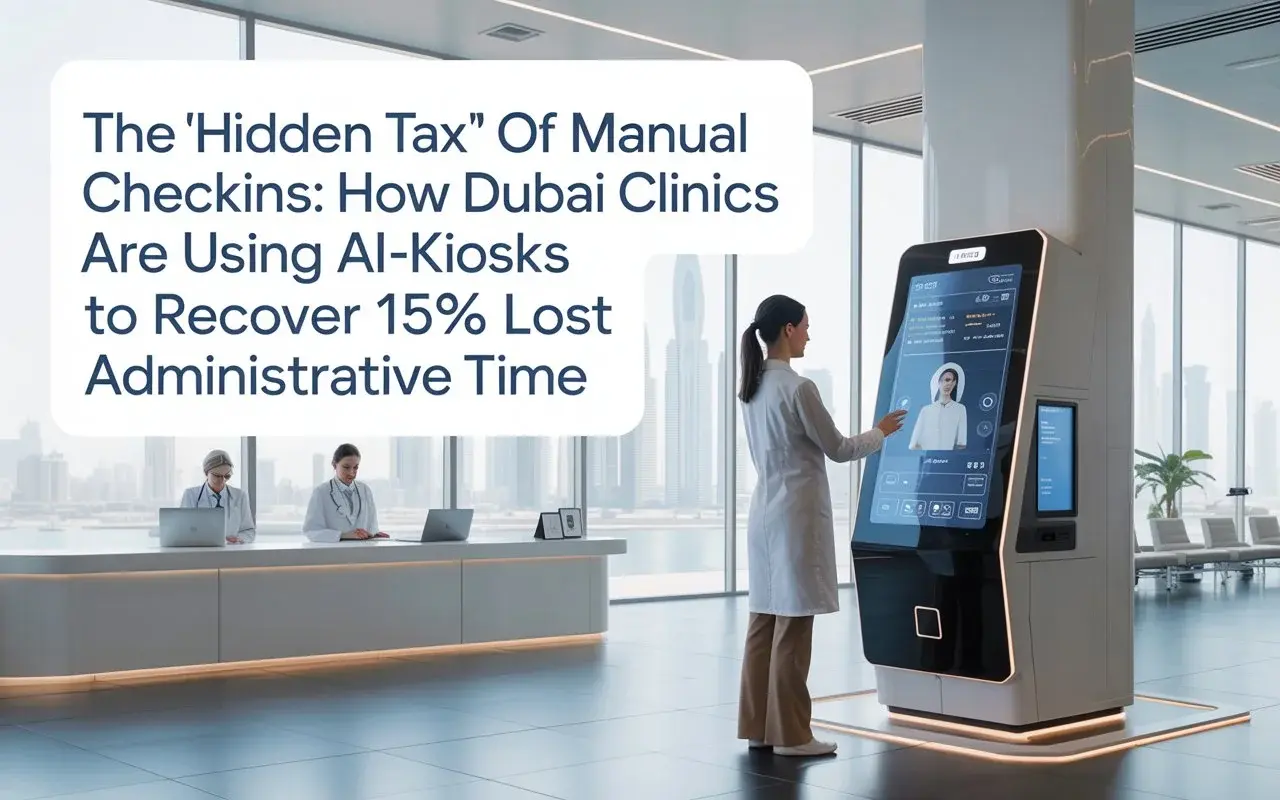
The “Hidden Tax” of Manual Check-ins: How Dubai Clinics Are Using AI-Kiosks to Recover 15% in Lost Administrative Time
Modern patient check-in kiosks Dubai medical centers deploy are actively eliminating the hidden operational drains pulling resources away from patient care. Every day, across hundreds of private clinics, something quiet and expensive is happening at the front desk. A patient walks in. A receptionist looks up. Papers shuffle. Insurance cards get photocopied. A form is handed over on a clipboard. A staff member types everything in—again—into a system that already partially holds the data.
This is the hidden tax. Nobody invoices it. No CFO line-item captures it cleanly. But healthcare administrators who have looked closely at their operational data know it’s real, it compounds daily, and it’s costing clinics an estimated 15% of total administrative working hours—hours that don’t produce care, don’t generate revenue, and don’t build patient loyalty.
In a market as competitive and compliance-intensive as the UAE’s private healthcare sector—governed strictly by the Dubai Health Authority (DHA) and increasingly benchmarked against rigorous international standards—that 15% gap is no longer acceptable. This is why forward-thinking clinic operators are turning to AI-powered patient check-in kiosks Dubai systems to provide a measurable, long-term operational fix.
What Is the “Hidden Tax” of Manual Check-In?
The phrase “hidden tax” refers to operational costs that are real but not directly visible on a traditional P&L statement. In clinic administration, the absence of automated patient check-in kiosks Dubai networks rely on surfaces via four distinct bottlenecks:
- Duplicate Data Entry: Patient information captured verbally or on paper forms gets re-entered manually into the clinic management system (CMS) by front desk staff. This process is slow and entirely redundant.
- Staff Bottlenecking at Peak Hours: Between 9 AM and 12 PM, most clinics experience 60–70% of their daily walk-in volume. Without automated intake, one or two receptionists become single points of failure. Queue times rise and patient dissatisfaction peaks.
- Insurance Eligibility Verification Delays: Manual verification of insurance coverage—cross-checking policy numbers, network tiers, and co-pay amounts—can easily consume 4 to 8 minutes per patient.
- Compliance Documentation Gaps: DHA-mandated documentation, including consent forms and Emirates ID verification, must be collected at the point of check-in. When done manually, forms get misplaced, creating audit risks.
What Is an AI-Powered Patient Check-In Kiosk?
An AI-powered self-service terminal automates the patient intake process from arrival to seat. It is not simply a digital form. The automated intelligence refers to the system’s ability to read complex documents, verify identity, cross-reference databases in real time, and adapt the intake workflow dynamically based on patient type, visit reason, and insurance profile.
Deploying high-quality patient check-in kiosks Dubai facilities integrate within their offices allows clinics to perform essential regional workflows, including optical character recognition (OCR) scanning of Emirates IDs and live eligibility verification against local payer networks like Daman and Dubai Insurance Company. Furthermore, these platforms coordinate with larger health information systems. You can read more about how these interconnected data networks operate by reading about the mechanics of a Health Information Exchange on Wikipedia.
Core Attributes of High-Performance Kiosk Systems
The performance gap between entry-level digital intake tools and purpose-built patient check-in kiosks Dubai networks demand is significant. High-performing systems are defined by key attributes:
Real-Time Insurance Eligibility Engine
When utilizing the best patient check-in kiosks Dubai has to offer, connecting live to insurance clearinghouses—verifying active coverage, co-pay amounts, and benefit limits at the moment of check-in—eliminates manual verification steps entirely. Clinics using live eligibility engines report a reduction in billing disputes of up to 30% because the financial terms are confirmed before the patient sees the physician.
Adaptive Intake Logic and Biometrics
Rather than presenting every patient with the same generic form, advanced patient check-in kiosks Dubai clinics utilize leverage conditional logic to reduce completion times by 40%. Concurrently, camera-based passport and Emirates ID reading combined with liveness detection confirms patient identity, completely eliminating the risk of identity mix-ups or duplicate record creation.
EMR/HMS Bi-Directional Integration
The system must write data directly into the clinic’s existing system of record rather than creating a parallel data silo. Best-in-class implementations push verified patient data seamlessly into the electronic medical record (EMR) or hospital management system (HMS), shifting the receptionist’s role from raw data entry to premium patient experience management.
The 15% Time Recovery: Where It Comes From
The claim that integrating patient check-in kiosks Dubai healthcare systems provide helps clinics recover 15% of administrative time is highly specific. Based on operational data from mid-size clinics processing 30–80 daily patient visits, the time recovery distributes across four core categories:
| Administrative Category | Percentage of Total Time Recovered | Operational Impact on Staff Capacity |
|---|---|---|
| Insurance Verification | 38% of recovered time | Eliminates manual eligibility calls and payer portal lookups, saving 3–4 hours daily. |
| Duplicate Data Entry | 28% of recovered time | OCR document scanning auto-populates the CMS, removing manual typing bottlenecks. |
| Compliance Documentation | 20% of recovered time | Digital consent forms with e-signatures eliminate paper-chasing in DHA audit cycles. |
| Queue & Flow Management | 14% of recovered time | Automated queue assignment minimizes ad-hoc verbal traffic between reception and patients. |
Use Cases: Which Dubai Clinics Benefit Most?
The return on investment varies based on case mix and volume. Multispecialty polyclinics see high volumes of working professionals who actively prefer the self-service interfaces provided by patient check-in kiosks Dubai vendors. Diagnostics and radiology centers benefit by having kiosks validate complex referral numbers and confirm insurance pre-authorizations automatically, eliminating costly patient mix-ups.
Similarly, dental group practices and corporate health clinics use these tools to capture visit reasons, current medications, and allergy data during intake, reducing consultation friction and instantly improving clinical documentation quality.
Evaluating the Competitive Landscape
When studying the options for patient check-in kiosks Dubai medical directors can acquire, it helps to look at the market alternatives:
- Traditional Paper-Based Intake: Zero upfront capital cost but maximum ongoing operational drag in staff time, high error rates, and compliance risks.
- Basic Digital Forms (Tablet-Based): A slight step up from paper, but data still typically requires manual verification and re-entry into the CMS unless custom integrations are built.
- Full AI-Kiosk Platforms: Purpose-built systems combining heavy-duty kiosk hardware, OCR document reading, live insurance eligibility, and bi-directional EMR integration. These represent the highest operational return on investment.
Implementation Overview: What Deployment Looks Like
The implementation journey for patient check-in kiosks Dubai facilities adopt typically follows a structured sequence over an 8-week horizon. It begins with a vendor audit of the clinic’s existing CMS and physical space layout to optimize kiosk placement. Technical integration follows, connecting the kiosk to the CMS via secure APIs. Staff are then trained on how their roles evolve toward exception handling, leading into a soft-launch calibration period to fine-tune the system’s identity verification engines before full deployment.
Conclusion: Setting the New Operational Standard
The hidden tax of manual check-in is not going to resolve itself. Staff wages are not declining, regulatory compliance requirements are not getting simpler, and patient expectations are higher than ever. Incorporating the top patient check-in kiosks Dubai markets offer ensures your administrative infrastructure is optimized for long-term growth.
For clinics deploying patient check-in kiosks Dubai patients trust, a 15% recovery in administrative time is a massive efficiency gain. Redirected toward premium patient experience and clinical coordination, that recovered capacity produces compounding returns. To upgrade your clinic’s administrative infrastructure with fully compliant automation systems, explore the solutions available at AEC International today.
FAQs
- Is an AI check-in kiosk compliant with Dubai Health Authority requirements?
Yes, compliant patient check-in kiosks Dubai vendors supply are fully aligned with the DHA’s Health Data Protection Standard (HDPS), utilizing encrypted transmission and local cloud hosting. - How long does it take for a clinic to see measurable ROI?
For clinics seeing 40+ patients per day, the time savings, paired with reduced billing disputes and fewer compliance documentation gaps, typically offset system costs within 8 to 14 months. - Can these systems effectively handle walk-in patients?
Absolutely. For walk-in patients, the kiosk collects full demographic profiles, maps their insurance network compatibility, and flags them for triage review based on visit urgency.