

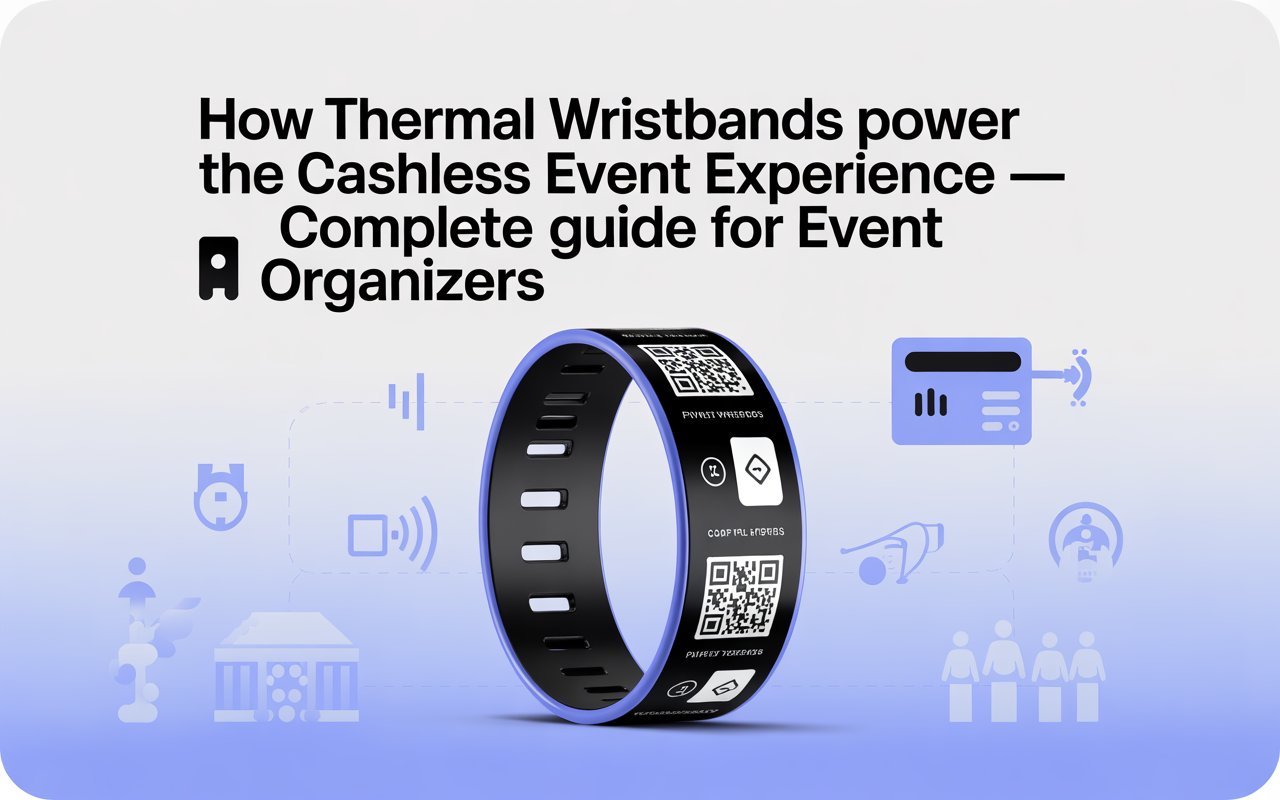
How Thermal Wristbands Power the “Cashless” Event Experience: A Complete Guide for Event Organizers
The Problem Every Event Organizer Knows Too Well
You have 8,000 attendees arriving in a two-hour window. Your staff is stretched thin across entry lanes. Somewhere in the crowd, someone is wearing a copied wristband they bought off a resale forum. At the food stalls, cash handling is slowing every transaction by 40 seconds. By the time your headliner goes on, you have lost thousands in potential revenue, dealt with three fraud incidents, and your operations team is running on stress alone.
This is not a hypothetical. It is the operational reality for festival directors, stadium managers, conference organizers, and venue operators around the world. The gap between a smooth event and a chaotic one often comes down to one overlooked tool sitting right on the attendee’s wrist.
Direct thermal wristbands — when implemented correctly and integrated with cashless payment infrastructure — solve each of these problems simultaneously. They do it quietly, quickly, and at a cost that makes the return on investment obvious within a single event cycle.
This article breaks down exactly how thermal wristbands work, what makes them fraud-resistant, how they connect to cashless ecosystems like AEC INT’s payment terminals, and why more event organizers are treating them as mission-critical equipment rather than an afterthought.
What Are Direct Thermal Wristbands?
Direct thermal wristbands are wearable access credentials printed without ink or toner. Instead of traditional ribbon-based printing, a thermal printhead applies heat directly to a chemically treated wristband surface, producing sharp text, barcodes, and QR codes instantly.
The result is a waterproof, smudge-resistant wristband that comes off the printer in under three seconds, ready to go directly onto an attendee’s wrist at the entry gate.
These are not your grandfather’s paper event wristbands. Modern direct thermal wristbands are engineered with:
- Heat-sensitive coating that reacts to precise temperature ranges from the printhead
- Adhesive closure systems with tamper-evident properties (more on this below)
- Variable data printing capability, meaning every single wristband carries unique information — name, ticket tier, QR code, event date
- Material durability rated for multi-day wear, moisture exposure, and physical activity
The distinction between direct thermal and thermal transfer matters here. Thermal transfer printing uses a ribbon to transfer ink onto the substrate. Direct thermal prints directly onto the treated surface, eliminating ribbon costs, reducing mechanical complexity, and enabling the sub-3-second print speeds that gate operations demand.
For high-throughput events, this difference is not trivial. It is the difference between a gate that processes 400 people per hour and one that processes 800.
Core Attributes and Features: What Makes Thermal Wristbands Event-Ready
Understanding the feature set of thermal wristbands is not just a technical exercise. Each attribute maps directly to a real operational challenge that event organizers face.
1. On-Demand Personalization — Printing Names and QR Codes in Under 3 Seconds
The era of pre-printed generic wristbands is ending. Attendees increasingly expect personalization, and event organizers increasingly need it for security and data purposes.
With thermal wristband printers deployed at entry gates, staff can:
- Pull up a ticket holder’s registration data from the event management system
- Print the attendee’s full name, ticket category, access zones, and a unique QR code
- Apply the wristband — all within a single gate interaction lasting under 15 seconds total
The print time itself? Under three seconds per band on modern direct thermal hardware.
This on-demand model offers three advantages that static pre-printing cannot match:
Security uplift: A wristband printed with a specific name and a dynamically generated QR code tied to a single-use validation token cannot be transferred or duplicated the way a generic colored band can. The uniqueness is built in at the point of issuance.
Operational flexibility: If ticket holders upgrade their tier at the gate, swap access zones, or require a reprint due to loss, the system handles it in real time. There is no box of pre-printed bands to sort through.
Data capture: Every print event is logged. You know exactly which wristband was issued to which attendee, at which gate, at what time. This audit trail is invaluable for post-event analytics, fraud investigations, and access reporting.
2. Tamper-Evidence — The Shred-on-Removal Adhesive
Wristband fraud is more organized than most venue managers realize. At large festivals, secondary markets for used or counterfeit wristbands can emerge within hours of an event opening. Reusing, transferring, or duplicating a wristband is the primary attack vector.
Thermal wristbands designed for event use incorporate what the industry calls “shred-on-removal” or “destructive adhesive” closures. Here is precisely how this works:
The adhesive tab on the wristband is engineered to bond permanently with the material substrate. When you attempt to peel the wristband off, the substrate tears at the adhesive point. The structural integrity of the wristband is destroyed. There is no peeling it off cleanly, no re-sealing it, no transferring it.
This design achieves several things:
- Unauthorized removal is visible: A wristband that has been tampered with is immediately obvious to gate staff and security personnel at a glance
- Transfer is impossible: Because the band shreds on removal, the person who originally received it cannot hand it to someone else without destroying it
- Reuse is eliminated: Even if someone salvages a portion of the band, the broken adhesive point and shredded material make it non-functional as an access credential
For multi-day events, this is especially critical. Day 2 and Day 3 attendance fraud through wristband sharing is a well-documented revenue leak. Shred-on-removal adhesives close that gap structurally rather than relying on staff vigilance alone.
Some thermal wristband models also incorporate ultraviolet (UV) reactive inks as a secondary verification layer, allowing handheld UV scanners to instantly confirm authenticity at internal checkpoints throughout the venue.
3. Integration with Cashless Payment Terminals
This is where thermal wristbands move from a security tool to a revenue generation engine.
The cashless event model works like this: attendees load credit onto their wristband account (via app, kiosk, or gate top-up station) before or during entry. When they purchase food, beverages, merchandise, or any other in-venue service, they tap or scan their wristband. The transaction clears in approximately 1–2 seconds. No cash changes hands. No card readers needed at every stall.
AEC INT’s cashless payment terminals are built to interface directly with the QR code or NFC data embedded in thermal wristbands. The integration pipeline typically works as follows:
Step 1 — Account creation at registration: When the attendee’s wristband is printed at the gate, the unique QR code on that wristband is linked to their account in the event’s cashless platform. This happens automatically during the gate printing workflow.
Step 2 — Preloading credit: Attendees can preload via the event app, a self-service kiosk, or by handing cash to a top-up attendant who loads the amount digitally. The balance is attached to the wristband ID.
Step 3 — Point-of-sale scanning: At every food vendor, bar, merchandise stand, or activity zone equipped with AEC INT terminals, the vendor simply scans the QR code on the attendee’s wristband. The terminal pulls the account balance, processes the deduction, and displays confirmation — in under two seconds.
Step 4 — Real-time reporting: Every transaction is logged centrally. Event organizers can monitor live revenue across all vendor points from a single dashboard. They can see which stalls are busy, which items are selling, and how much credit remains unspent across all accounts.
Step 5 — Post-event reconciliation: Unspent credit is automatically refunded per the event’s refund policy. The transaction log serves as the complete financial record of all in-venue spending.
Real-World Use Cases and Industries Served
Thermal wristbands integrated with cashless payment infrastructure are not limited to music festivals. The applications span a wide range of live event formats:
Music Festivals and Concerts The original and still dominant use case. Multi-day festivals with tens of thousands of attendees benefit most from the combination of fraud-resistant issuance, on-demand personalization, and cashless F&B operations.
Sporting Events and Stadiums Season ticket holders, hospitality zone access, VIP lounges — thermal wristbands allow tiered access management without requiring staff to memorize zone eligibility. The wristband carries the access permissions; the terminal enforces them.
Corporate Conferences and Trade Shows Badge replacement with wristbands is gaining traction in the conference sector. Printed attendee names and company affiliations on the wristband serve both as an access credential and a networking conversation starter.
Theme Parks and Attractions For ticketed attractions with multiple zones, ride access, and in-park dining, cashless wristbands eliminate the need for guests to carry wallets throughout the venue. The wristband is their wallet, their ticket, and their identity in a single accessory.
Water Parks and Aquatic Venues Direct thermal wristbands are specifically suited for wet environments. The waterproof substrate and adhesive maintain integrity even after hours of water exposure, making them the preferred choice for pool and waterpark operations.
Private Members’ Clubs and VIP Experiences For exclusive events where access control and spending tracking need to happen invisibly, thermal wristbands provide the infrastructure without the aesthetic intrusion of lanyards and badge holders.
How Thermal Wristbands Compare to Alternative Credential Formats
It is worth addressing why thermal wristbands outperform other common credential formats in the specific context of cashless event integration.
Paper tickets and PDF tickets function as entry credentials but carry no ongoing data. Once scanned at the gate, they are inert. They cannot link to a payment account, cannot be scanned at vendor points, and cannot carry access tier information dynamically.
Generic colored fabric wristbands (the traditional model) provide zero personalization, minimal tamper evidence, and no data integration capability. They are suitable for very small, low-fraud-risk events only.
NFC wristbands and RFID wristbands are the primary alternative to QR-based thermal wristbands at scale. NFC/RFID systems offer tap-and-go convenience without requiring a visible code to be displayed. However, they carry higher per-unit costs, require specialized issuance equipment at every gate, and are more complex to integrate with diverse vendor terminal networks. For events with established AEC INT terminal infrastructure, QR-based thermal wristbands offer a more cost-efficient integration path with equivalent transaction speeds.
Mobile wallet passes (Apple Wallet, Google Wallet) are increasingly viable for single-entry ticketing but fall short for wristband-based operations. They require attendees to have their phone accessible at every transaction point, create dependency on battery life, and cannot replicate the physical durability and hands-free convenience of a wristband credential.
The thermal wristband sits at the intersection of low per-unit cost, high personalization capability, strong fraud resistance, and seamless integration — a combination no single competing format fully matches.
Implementation Overview: Deploying Thermal Wristbands at Your Event
Rolling out a thermal wristband system integrated with cashless terminals is a structured process. Here is a practical overview of what deployment looks like from the organizer’s perspective:
Phase 1 — System Design and Integration Mapping (4–8 weeks pre-event)
Work with your wristband supplier and payment terminal provider (AEC INT) to map the data flow between your event management platform, the wristband printing system, and the payment backend. Define your access tiers, QR code data structure, and account provisioning logic. Confirm compatibility between your printer models and the AEC INT terminal scanning protocol.
Phase 2 — Hardware Procurement and Setup
Source the appropriate direct thermal wristband printers for your gate count. A standard deployment uses one printer per gate lane, with a buffer unit per four lanes in case of hardware failure. Stock wristband media appropriate for your event duration (single-day vs. multi-day media have different adhesive ratings). Set up cashless top-up kiosks and self-service stations at designated locations within the venue.
Phase 3 — Staff Training (1–2 weeks pre-event)
Gate staff need to know how to operate the printer, handle reprint requests, manage the wristband application correctly (wrinkle-free application affects QR code scan reliability), and troubleshoot common issues. Vendor staff need to know how to operate AEC INT terminals, handle low-balance situations, and process refund requests.
Phase 4 — Gate Day Execution
On event day, the gate printing workflow should be: scan ticket > pull attendee record > print wristband > apply to wrist > gate opens. With well-trained staff and properly configured systems, this entire sequence runs under 15 seconds. For pre-registered attendees with mobile tickets, many events pre-stage wristbands alphabetically to reduce print demand at peak arrival windows.
Phase 5 — Live Monitoring and Post-Event Reconciliation
Monitor the central dashboard in real time during the event. Flag any wristband IDs that attempt to scan at multiple entry points simultaneously (a red flag for QR code duplication attempts). After the event, run the full reconciliation report: total transactions, total revenue by vendor, unspent credit pool, and refund processing queue.
Frequently Asked Questions
Q1: What is the difference between a direct thermal wristband and a regular event wristband?
A regular event wristband — whether fabric, Tyvek, or vinyl — is either pre-printed in bulk or left blank. It carries no unique data, cannot be linked to a digital account, and provides only visual or color-coded access control. A direct thermal wristband is printed on-demand with personalized data: the attendee’s name, a unique QR code, access tier information, and a timestamp. That data connects physically on the wrist to the digital cashless payment system behind the scenes. The gap between the two is the gap between a hotel room key card and a handwritten note saying “room 412.”
Q2: How does the shred-on-removal adhesive actually prevent wristband sharing or fraud?
The adhesive on a tamper-evident thermal wristband is engineered to bond permanently with the wristband substrate during closure. Unlike standard sticker or tape adhesives that peel cleanly, the shred-on-removal design causes the wristband material to tear apart at the bond point when removal is attempted. The destruction is irreversible and immediately visible. There is no technique to remove the band cleanly and re-apply it to another person’s wrist. This is a material engineering solution to a human behavior problem — and it works because it removes the option rather than relying on enforcement.
Q3: How long does it take to print and apply a thermal wristband at the gate?
The print cycle on a modern direct thermal wristband printer runs at under 3 seconds per band. The full gate interaction — scanning the attendee’s ticket, pulling their record, printing the wristband, and applying it — typically takes 10–15 seconds with a trained gate agent. This compares favorably to manual wristband application without printing (4–6 seconds) but with zero personalization, and to RFID encoding processes which can take 8–12 seconds just for the encoding step alone.
Q4: Can the thermal wristband QR code be photographed and duplicated?
This is the most technically asked question in cashless event deployment. The answer is: duplication is possible but single-use token validation makes it irrelevant. Each QR code on a thermal wristband links to a unique session token in the backend. When that token is validated at entry, it is marked as used. Any subsequent scan of the same QR code — whether from the original wristband or a photograph of it — triggers a duplicate-scan alert at the gate. The system, not the staff, catches this. Combined with the physical wristband requirement at internal checkpoints, QR duplication attacks have no practical path to success.
Q5: What happens to unspent cashless credit after the event?
Unspent credit is handled per the event organizer’s configured refund policy within the cashless platform. Most implementations offer one of three options: automatic refund to the original payment method within 5–10 business days, credit transfer to a future event (for recurring festivals or venue members), or charitable donation opt-in during the post-event checkout flow. AEC INT’s platform supports all three models with automated processing, eliminating the manual reconciliation burden that cash-based refund systems create.
Q6: Are thermal wristbands waterproof enough for outdoor and aquatic events?
Yes, provided you specify the correct media for your event environment. Direct thermal wristband materials are available in polypropylene and polyester substrates that are fully waterproof and rated for immersion. The thermal print image on these substrates is heat-fused into the coating, not printed on top of it, which means it does not wash or rub off in rain, sweat, or pool water. For standard outdoor festivals, standard Tyvek-based thermal wristbands are water-resistant and suitable for multi-day wear. For aquatic environments, polypropylene wristband media is the appropriate specification.
Q7: How do AEC INT cashless terminals connect to the wristband system?
The integration is handled at the platform level, not the hardware level. When a wristband is printed at the gate, the wristband’s unique QR code is registered in the event’s cashless backend and linked to the attendee’s account. AEC INT terminals are pre-configured to communicate with that same backend via a secure API. When a vendor scans a wristband, the terminal sends the QR code value to the backend, which returns the account balance and processes the transaction. The terminal itself does not need to know anything about the wristband — it simply reads the code and calls the API. This architecture means any QR-capable AEC INT terminal across the entire venue shares the same account database in real time.
Conclusion: The Wristband Is Your Revenue Infrastructure
Event organizers who treat the wristband as a cosmetic finishing touch are leaving real money on the table — and opening operational vulnerabilities that cost even more to manage reactively.
Direct thermal wristbands integrated with cashless payment infrastructure like AEC INT‘s terminal network represent a shift in how events are fundamentally structured. The wristband becomes the connective tissue between physical access control, fraud prevention, attendee identity, and commerce. Every element reinforces the others.
The on-demand personalization means no two wristbands are alike — which means counterfeiting and sharing are impractical before an attacker even starts. The shred-on-removal adhesive means removal is destruction, full stop. The QR code integration means every transaction across your entire venue is centrally logged, reconciled automatically, and revenue-maximizing through cashless frictionlessness.
For event organizers evaluating their operational stack for the next event cycle, this is not a luxury upgrade. It is the operational baseline that modern high-throughput events require to protect revenue, manage access at scale, and deliver the attendee experience that keeps people coming back.
The technology is proven. The integration is established. The question is simply whether your next event runs on infrastructure built for scale — or infrastructure that was never really designed for what you’re asking it to do.